
Ch 27: Current and Resistance
Knight Calc - Physics for Scientists and Engineers 5th Edition
Knight Calc5th EditionPhysics for Scientists and EngineersISBN: 9780137344796Not the one you use?Change textbook
Chapter 27, Problem 66

A 2.0-mm-diameter wire formed from a composite material has a resistivity that decreases with distance along the wire as ρ=ρ₀e−αx, where ρ₀=4.0×10⁻⁵ Ω m, x (in m) is measured from one end of the wire, and the constant α=4.0 m−1. What is the resistance of a 50-cm-long length of this wire?

Verified step by step guidance
1
Step 1: Understand the problem. The wire has a resistivity that varies along its length according to the formula ρ = ρ₀e^−αx, where ρ₀ is the initial resistivity, α is a constant, and x is the distance from one end of the wire. We need to calculate the total resistance of a 50-cm-long wire, taking into account the varying resistivity.
Step 2: Recall the formula for resistance. Resistance R is given by the integral of resistivity ρ over the length of the wire, divided by the cross-sectional area A. Mathematically, R = ∫(ρ(x)/A) dx, where A = πr² is the cross-sectional area of the wire, and r is the radius of the wire.
Step 3: Calculate the cross-sectional area of the wire. The diameter of the wire is given as 2.0 mm, so the radius r = diameter/2 = 1.0 mm = 1.0 × 10^−3 m. Substitute this into A = πr² to find the area.
Step 4: Set up the integral for resistance. Substitute ρ(x) = ρ₀e^−αx and A = πr² into the formula for resistance: R = ∫(ρ₀e^−αx / πr²) dx. The limits of integration are from x = 0 to x = 0.50 m (since the wire is 50 cm long).
Step 5: Solve the integral. The integral of e^−αx with respect to x is (1/α)e^−αx. Apply the limits of integration (from 0 to 0.50 m) to find the total resistance R. Simplify the expression to get the final formula for R in terms of ρ₀, α, and the wire's dimensions.

Verified video answer for a similar problem:

This video solution was recommended by our tutors as helpful for the problem above.
Video duration:
3m
Was this helpful?

Key Concepts

Here are the essential concepts you must grasp in order to answer the question correctly.

Resistivity

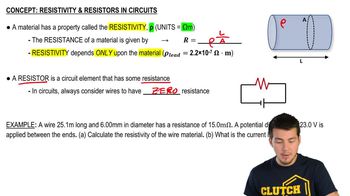
Resistivity is a material property that quantifies how strongly a given material opposes the flow of electric current. It is denoted by the symbol ρ and is measured in ohm-meters (Ω·m). In this problem, the resistivity of the wire varies with distance, which affects the overall resistance of the wire segment.
Recommended video:
Guided course
05:25
Resistivity & Resistors in Circuits

Resistance Calculation

Resistance (R) is calculated using the formula R = ρL/A, where ρ is the resistivity, L is the length of the conductor, and A is the cross-sectional area. For a cylindrical wire, the cross-sectional area can be determined using A = π(d/2)², where d is the diameter. In this case, the resistance must be integrated along the length of the wire due to the varying resistivity.
Recommended video:
Guided course
05:25
Resistivity & Resistors in Circuits

Integration in Physics

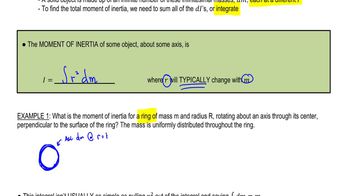
Integration is a mathematical technique used to find the total value of a quantity that varies over a certain range. In this context, it is necessary to integrate the resistance contributions along the length of the wire, as the resistivity changes with distance. This allows for the calculation of the total resistance of the wire segment by summing the infinitesimal resistances over its length.
Recommended video:
Guided course
11:43
Finding Moment Of Inertia By Integrating
Related Practice
Textbook Question

A 300 μF capacitor is charged to 9.0 V, then connected in parallel with a 5000 Ω resistor. The capacitor will discharge because the resistor provides a conducting pathway between the capacitor plates, but much more slowly than if the plates were connected by a wire. Let t=0 s be the instant the fully charged capacitor is first connected to the resistor. At what time has the capacitor voltage decreased by half, to 4.5 V?

63
views
Textbook Question

You've decided to protect your house by placing a 5.0-m-tall iron lightning rod next to the house. The top is sharpened to a point and the bottom is in good contact with the ground. From your research, you've learned that lightning bolts can carry up to 50 kA of current and last up to 50 μs. You don't want the potential difference between the top and bottom of the lightning rod to exceed 100 V. What minimum diameter must the rod have?

70
views
Textbook Question

You've decided to protect your house by placing a 5.0-m-tall iron lightning rod next to the house. The top is sharpened to a point and the bottom is in good contact with the ground. From your research, you've learned that lightning bolts can carry up to 50 kA of current and last up to 50 μs. How much charge is delivered by a lightning bolt with these parameters?

105
views
Textbook Question

Two 10-cm-diameter metal plates 1.0 cm apart are charged to ±12.5 nC. They are suddenly connected together by a 0.224-mm-diameter copper wire stretched taut from the center of one plate to the center of the other. Does the current increase with time, decrease with time, or remain steady? Explain.

42
views
Textbook Question

An aluminum wire consists of the three segments shown in FIGURE P27.64. The current in the top segment is 10 A. For each of these three segments, find the drift velocity vd. Place your results in a table for easy viewing.

125
views