Ch 20: The Micro/Macro Connection
Knight Calc - Physics for Scientists and Engineers 5th Edition
Knight Calc5th EditionPhysics for Scientists and EngineersISBN: 9780137344796Not the one you use?Change textbook
Chapter 20, Problem 63

A water molecule has its three atoms arranged in a 'V' shape, so it has rotational kinetic energy around any of three mutually perpendicular axes. However, like diatomic molecules, its vibrational modes are not active at temperatures below 1000 K. What is the thermal energy of 2.0 mol of steam at a temperature of 160°C?

Verified step by step guidance
1
Step 1: Convert the given temperature from Celsius to Kelvin. Use the formula: T=T+273.15, where T is the temperature in Celsius.
Step 2: Determine the degrees of freedom for a water molecule. Since water is a nonlinear molecule, it has 3 translational and 3 rotational degrees of freedom, totaling 6 degrees of freedom.
Step 3: Use the formula for the thermal energy of an ideal gas: E=12fnRT, where f is the degrees of freedom, n is the number of moles, R is the gas constant (8.314 J/mol·K), and T is the temperature in Kelvin.
Step 4: Substitute the values into the formula. For this problem, f = 6, n = 2.0 mol, R = 8.314 J/mol·K, and T is the temperature in Kelvin calculated in Step 1.
Step 5: Perform the multiplication and addition operations to calculate the thermal energy. Ensure the units are consistent throughout the calculation (Joules).

Verified video answer for a similar problem:

This video solution was recommended by our tutors as helpful for the problem above.
Video duration:
4m
Was this helpful?

Key Concepts

Here are the essential concepts you must grasp in order to answer the question correctly.

Thermal Energy

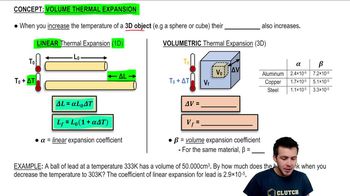
Thermal energy is the total kinetic energy of the particles in a substance due to their motion. It is directly related to temperature, where higher temperatures correspond to greater thermal energy. In the context of gases, thermal energy can be calculated using the formula E = nRT, where E is the thermal energy, n is the number of moles, R is the ideal gas constant, and T is the temperature in Kelvin.
Recommended video:
Guided course
05:21
Volume Thermal Expansion

Ideal Gas Law

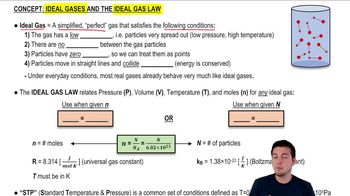
The Ideal Gas Law is a fundamental equation in thermodynamics that relates the pressure, volume, temperature, and number of moles of an ideal gas. It is expressed as PV = nRT, where P is pressure, V is volume, n is the number of moles, R is the ideal gas constant, and T is temperature in Kelvin. This law is essential for calculating properties of gases under various conditions.
Recommended video:
Guided course
07:21
Ideal Gases and the Ideal Gas Law

Molecular Vibrations and Rotations

Molecular vibrations and rotations refer to the movements of atoms within a molecule. In water, the 'V' shape allows for rotational kinetic energy around three axes. However, vibrational modes become significant only at higher temperatures (above 1000 K for water), affecting the molecule's thermal energy and behavior. Understanding these modes is crucial for analyzing the thermal properties of substances.
Recommended video:
Guided course
01:50
Introduction to Kinetic-Molecular Theory