
Textbook Question
A particle's velocity is described by the function vₓ = (t² - 7t + 10) m/s, where t is in s. What is the particle's acceleration at each of the turning points?
1889
views

 Verified step by step guidance
 03:04
03:04
 7:27
7:27 10:13
10:13A particle's velocity is described by the function vₓ = (t² - 7t + 10) m/s, where t is in s. What is the particle's acceleration at each of the turning points?
The vertical position of a particle is given by the function y = (t2 - 4t + 2) m, where t is in s. What is the particle's position at that time?
A particle's velocity is described by the function vₓ =kt² m/s, where k is a constant and t is in s. The particle's position at t₀ = 0 s is x₀ = -9.0 m. At t₁ = 3.0 s, the particle is at x₁ = 9.0 m. Determine the value of the constant k. Be sure to include the proper units.
The position of a particle is given by the function x = (2t3 = 6t2 + 12) m, where t is in s. At what time does the particle reach its minimum velocity? What is (vx)min?
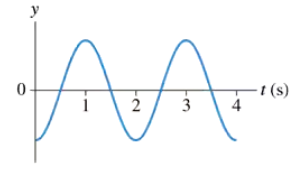
A block is suspended from a spring, pulled down, and released. The block's position-versus-time graph is shown in FIGURE P2.38. Draw a reasonable velocity-versus-time graph.
The position of a particle is given by the function x = (2t3 - 6t2 + 12) m, where t is in s. At what time is the acceleration zero?