Ch 11: Impulse and Momentum
Knight Calc - Physics for Scientists and Engineers 5th Edition
Knight Calc5th EditionPhysics for Scientists and EngineersISBN: 9780137344796Not the one you use?Change textbook
Chapter 11, Problem 51

An object at rest on a flat, horizontal surface explodes into two fragments, one seven times as massive as the other. The heavier fragment slides 8.2 m before stopping. How far does the lighter fragment slide? Assume that both fragments have the same coefficient of kinetic friction.

Verified step by step guidance
1
Step 1: Begin by applying the principle of conservation of momentum. Since the object was initially at rest, the total momentum before the explosion is zero. After the explosion, the momentum of the two fragments must still sum to zero. Let the mass of the lighter fragment be \( m \), and the mass of the heavier fragment be \( 7m \). If the velocities of the lighter and heavier fragments immediately after the explosion are \( v_1 \) and \( v_2 \), respectively, then \( m v_1 = 7m v_2 \). Solve for \( v_1 \) in terms of \( v_2 \): \( v_1 = 7v_2 \).

Step 2: Use the work-energy principle to relate the distance each fragment slides to its initial kinetic energy. The work done by friction is equal to the initial kinetic energy of each fragment. The work done by friction is \( W = f_k d \), where \( f_k \) is the kinetic friction force and \( d \) is the distance slid. The kinetic friction force is \( f_k = \mu_k m g \), where \( \mu_k \) is the coefficient of kinetic friction, \( m \) is the mass, and \( g \) is the acceleration due to gravity.
Step 3: Write the kinetic energy for each fragment. The initial kinetic energy of the lighter fragment is \( KE_1 = \frac{1}{2} m v_1^2 \), and for the heavier fragment, \( KE_2 = \frac{1}{2} (7m) v_2^2 \). Substitute \( v_1 = 7v_2 \) into \( KE_1 \): \( KE_1 = \frac{1}{2} m (7v_2)^2 = \frac{1}{2} m (49v_2^2) = 49 \cdot \frac{1}{2} m v_2^2 \).
Step 4: Relate the kinetic energy to the sliding distance for each fragment. For the heavier fragment, \( KE_2 = f_k d_2 \), where \( d_2 = 8.2 \, \text{m} \). For the lighter fragment, \( KE_1 = f_k d_1 \). Since \( f_k \) is proportional to mass, the ratio of distances \( d_1 \) and \( d_2 \) will depend on the ratio of their kinetic energies. Substitute \( KE_1 \) and \( KE_2 \) into the ratio: \( \frac{d_1}{d_2} = \frac{KE_1}{KE_2} = \frac{49 \cdot \frac{1}{2} m v_2^2}{\frac{1}{2} (7m) v_2^2} = \frac{49}{7} = 7 \).
Step 5: Solve for \( d_1 \) using the ratio \( \frac{d_1}{d_2} = 7 \). Since \( d_2 = 8.2 \, \text{m} \), \( d_1 = 7 \cdot d_2 = 7 \cdot 8.2 \). The lighter fragment slides 7 times farther than the heavier fragment.

Verified video answer for a similar problem:

This video solution was recommended by our tutors as helpful for the problem above.
Video duration:
16m
Was this helpful?

Key Concepts

Here are the essential concepts you must grasp in order to answer the question correctly.

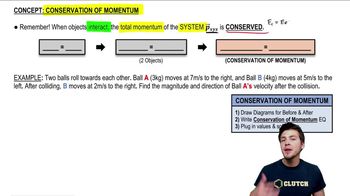
Conservation of Momentum

The principle of conservation of momentum states that in a closed system, the total momentum before an event must equal the total momentum after the event. In this scenario, since the object is initially at rest, the total momentum is zero. After the explosion, the momentum of the two fragments must also sum to zero, allowing us to relate their masses and velocities.
Recommended video:
Guided course
05:58
Conservation Of Momentum

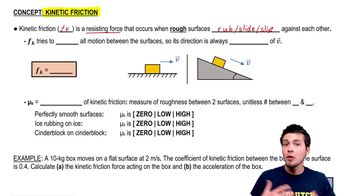
Friction and Kinetic Friction Coefficient

Friction is the force that opposes the relative motion of two surfaces in contact. The coefficient of kinetic friction quantifies this force and is constant for a given pair of surfaces. In this problem, both fragments experience the same frictional force, which affects how far they slide after the explosion, allowing us to compare their distances based on their masses.
Recommended video:
Guided course
06:18
Kinetic Friction Problems

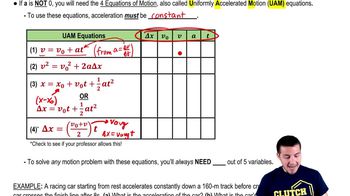
Kinematic Equations

Kinematic equations describe the motion of objects under constant acceleration. In this case, the acceleration is due to friction acting on the fragments after the explosion. By applying these equations, we can determine the distance each fragment travels based on its initial velocity and the deceleration caused by friction.
Recommended video:
Guided course
08:25
Kinematics Equations
Related Practice
Textbook Question

A bullet of mass m is fired into a block of mass M that is at rest. The block, with the bullet embedded, slides distance d across a horizontal surface. The coefficient of kinetic friction is μk .Find an expression for the bullet's speed vbullet.

2264
views
Textbook Question

Two 500 g blocks of wood are 2.0 m apart on a frictionless table. A 10 g bullet is fired at 400 m/s toward the blocks. It passes all the way through the first block, then embeds itself in the second block. The speed of the first block immediately afterward is 6.0 m/s . What is the speed of the second block after the bullet stops in it?

1875
views
Textbook Question

The stoplight had just changed and a 2000 kg Cadillac had entered the intersection, heading north at 3.0 m/s , when it was struck by a 1000 kg eastbound Volkswagen. The cars stuck together and slid to a halt, leaving skid marks angled 35° north of east. How fast was the Volkswagen going just before the impact?

2229
views
Textbook Question

A 1500 kg weather rocket accelerates upward at 10 m/s². It explodes 2.0 s after liftoff and breaks into two fragments, one twice as massive as the other. Photos reveal that the lighter fragment traveled straight up and reached a maximum height of 530 m. What were the speed and direction of the heavier fragment just after the explosion?

2166
views
Textbook Question

What is the speed of a 10g bullet that, when fired into a 10kg stationary wood block, causes the block to slide 5.0 cm across a wood table?

1785
views
Textbook Question

BIO Squids rely on jet propulsion to move around. A 1.50 kg squid (including the mass of water inside the squid) drifting at 0.40m/s suddenly ejects 0.100 kg of water to get itself moving at 2.50m/s . If drag is ignored over the small interval of time needed to expel the water (the impulse approximation), what is the water’s ejection speed relative to the squid?

1611
views