Ch 35: Optical Instruments
Knight Calc - Physics for Scientists and Engineers 5th Edition
Knight Calc5th EditionPhysics for Scientists and EngineersISBN: 9780137344796Not the one you use?Change textbook
Chapter 35, Problem 40

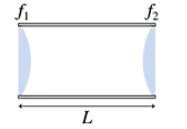
A simple and relatively inexpensive microscope eyepiece is the Ramsden eyepiece shown in FIGURE P35.40. Two plano-convex lenses have their curved surfaces facing each other, which a more advanced analysis shows is the orientation that minimizes spherical aberration. That same analysis finds that chromatic aberration is minimized with lens spacing L = 1/2 (f₁ + f₂). Your task is to design a 10x Ramsden eyepiece in which the first lens has a focal length of 30 mm. What are (a) the focal length and (b) the spacing of the second lens?

Verified step by step guidance
1
Step 1: Understand the problem requirements. The Ramsden eyepiece consists of two plano-convex lenses, and the goal is to design a 10x eyepiece. The magnification of the eyepiece is determined by the focal lengths of the lenses. The first lens has a focal length of 30 mm, and we need to find the focal length of the second lens and the spacing between the lenses.
Step 2: Recall the formula for the magnification of the eyepiece. The magnification (M) is given by the ratio of the focal lengths of the lenses: M = f₁ / f₂, where f₁ is the focal length of the first lens and f₂ is the focal length of the second lens. Rearrange this formula to solve for f₂: f₂ = f₁ / M.
Step 3: Substitute the given values into the formula. The magnification is 10x, and the focal length of the first lens is 30 mm. Use the formula f₂ = f₁ / M to calculate the focal length of the second lens. This step will give you the value of f₂.
Step 4: Use the formula for lens spacing to find the distance between the lenses. Chromatic aberration is minimized when the spacing L between the lenses is given by L = 1/2 (f₁ + f₂). Substitute the values of f₁ and f₂ into this formula to calculate L.
Step 5: Verify the results conceptually. Ensure that the calculated focal length of the second lens and the spacing between the lenses align with the design requirements for a Ramsden eyepiece and the principles of minimizing chromatic aberration and spherical aberration.

Verified video answer for a similar problem:

This video solution was recommended by our tutors as helpful for the problem above.
Was this helpful?

Key Concepts

Here are the essential concepts you must grasp in order to answer the question correctly.

Ramsden Eyepiece

The Ramsden eyepiece is a type of optical device used in microscopes, consisting of two plano-convex lenses arranged with their curved surfaces facing each other. This configuration helps to reduce spherical aberration, which occurs when light rays passing through a lens do not converge at a single point. The design is particularly valued for its simplicity and effectiveness in providing a magnified image.

Focal Length

The focal length of a lens is the distance from the lens to the point where parallel rays of light converge after passing through the lens. In the context of the Ramsden eyepiece, the focal lengths of the two lenses determine the overall magnification and image quality. The relationship between the focal lengths of the two lenses is crucial for achieving the desired magnification, such as the specified 10x in this problem.
Recommended video:
Guided course
10:54
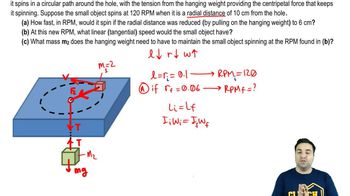
Spinning on a string of variable length

Chromatic Aberration

Chromatic aberration is an optical phenomenon that occurs when a lens fails to focus all colors of light to the same convergence point, resulting in a blurred or distorted image. In the Ramsden eyepiece, minimizing chromatic aberration is achieved by adjusting the spacing between the two lenses. The optimal spacing is given by the formula L = 1/2 (f₁ + f₂), where f₁ and f₂ are the focal lengths of the two lenses, ensuring that the eyepiece produces a clearer image.
Recommended video:
Guided course
05:42
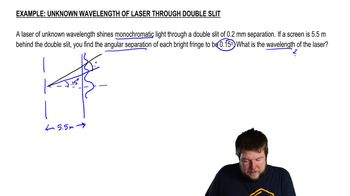
Unknown Wavelength of Laser through Double Slit
Related Practice
Textbook Question

A microscope with a tube length of 180 mm achieves a total magnification of 800x with a 40x objective and a 20x eyepiece. The microscope is focused for viewing with a relaxed eye. Approximately how far is the sample from the objective lens?

1508
views
Textbook Question

White light is incident onto a 30° prism at the 40° angle shown in FIGURE P35.41. Violet light emerges perpendicular to the rear face of the prism. The index of refraction of violet light in this glass is 2.0% larger than the index of refraction of red light. At what angle Φ does red light emerge from the rear face?

1655
views
Textbook Question

The resolution of a digital camera is limited by two factors: diffraction by the lens, a limit of any optical system, and the fact that the sensor is divided into discrete pixels. Consider a typical point-and-shoot camera that has a 20-mm-focal-length lens and a sensor with 2.5μm x 2.5 μm pixels. What is the f-number of the lens for the diameter you found in part b? Your answer is a quite realistic value of the f-number at which a camera transitions from being pixel limited to being diffraction limited. For f-numbers smaller than this (larger-diameter apertures), the resolution is limited by the pixel size and does not change as you change the aperture. For f-numbers larger than this (smaller-diameter apertures), the resolution is limited by diffraction, and it gets worse as you “stop down” to smaller apertures.

1539
views
Textbook Question

Marooned on a desert island and with a lot of time on your hands, you decide to disassemble your glasses to make a crude telescope with which you can scan the horizon for rescuers. Luckily you’re farsighted, and, like most people, your two eyes have different lens prescriptions. Your left eye uses a lens of power +4.5 D, and your right eye’s lens is +3.0 D. Which lens should you use for the objective and which for the eyepiece? Explain.

100
views
Textbook Question

High-power lasers are used to cut and weld materials by focusing the laser beam to a very small spot. This is like using a magnifying lens to focus the sun's light to a small spot that can burn things. As an engineer, you have designed a laser cutting device in which the material to be cut is placed 5.0 cm behind the lens. You have selected a high-power laser with a wavelength of 1.06 μm. Your calculations indicate that the laser must be focused to a 5.0-μm-diameter spot in order to have sufficient power to make the cut. What is the minimum diameter of the lens you must install?

1444
views
Textbook Question

Modern microscopes are more likely to use a camera than human viewing. This is accomplished by replacing the eyepiece in Figure 35.14 with a photo-ocular that focuses the of the objective to a real on the sensor of a digital camera. Suppose the sensor is 22.5 mm wide, a typical value, with 4.0 μm x 4.0 μm pixels. The photo of a cell is 120 pixels in diameter. What is the cell’s actual diameter, in μm?

79
views