Ch 36: Special Relativity
Knight Calc - Physics for Scientists and Engineers 5th Edition
Knight Calc5th EditionPhysics for Scientists and EngineersISBN: 9780137344796Not the one you use?Change textbook
Chapter 36, Problem 27

An event has spacetime coordinates (x,t) = (1200 m, 2.0 μs) in reference frame S. What are the event's spacetime coordinates (a) in reference frame S' that moves in the positive x-direction at 0.80c and (b) in reference frame S'' that moves in the negative x-direction at 0.80c?

Verified step by step guidance
1
Step 1: Understand the problem. The event's spacetime coordinates are given in reference frame S as (x, t) = (1200 m, 2.0 μs). We need to find the transformed spacetime coordinates in two different reference frames, S' and S'', which are moving relative to S at velocities of 0.80c in the positive and negative x-directions, respectively. This requires the use of the Lorentz transformation equations.
Step 2: Write down the Lorentz transformation equations. For a reference frame moving at velocity v relative to another frame, the transformations for the coordinates are: x' = γ ( x - vt ) and t' = γ ( t - vx / c2 ) , where γ is the Lorentz factor given by γ = ( 1 / 1 - v / c 2 ) .
Step 3: Calculate the Lorentz factor γ for v = 0.80c. Substitute v = 0.80c into the formula for γ: γ = ( 1 / 1 - 0.80 2 ) . Simplify this expression to find γ.
Step 4: Apply the Lorentz transformation equations for S'. Substitute x = 1200 m, t = 2.0 μs (convert to seconds: t = 2.0 × 10⁻⁶ s), v = 0.80c, and γ (calculated in Step 3) into the equations for x' and t' . Perform the substitutions and simplify the expressions to find the transformed coordinates in S'.
Step 5: Repeat the process for S''. For the reference frame S'' moving in the negative x-direction at v = -0.80c, use the same Lorentz transformation equations but substitute v = -0.80c instead of 0.80c. Follow the same steps as in Step 4 to find the transformed coordinates in S''.

Verified video answer for a similar problem:

This video solution was recommended by our tutors as helpful for the problem above.
Video duration:
12m
Was this helpful?

Key Concepts

Here are the essential concepts you must grasp in order to answer the question correctly.

Spacetime Coordinates

Spacetime coordinates combine space and time into a single four-dimensional continuum, represented as (x, t). In this framework, an event is defined by its position in space (x) and its occurrence in time (t). Understanding spacetime is crucial for analyzing how different observers perceive the same event, especially in the context of special relativity.
Recommended video:
Guided course
05:17
Coordinates of Center of Mass of 4 objects

Lorentz Transformation

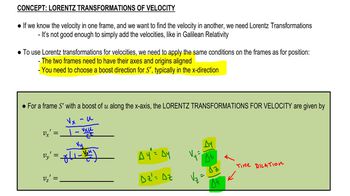
The Lorentz transformation equations relate the spacetime coordinates of an event as observed in different inertial reference frames moving relative to each other at a constant velocity. These transformations account for the effects of time dilation and length contraction, ensuring that the speed of light remains constant for all observers. They are essential for converting coordinates between frames S, S', and S'' in the given problem.
Recommended video:
Guided course
13:39
Lorentz Transformations of Velocity

Relative Velocity and Time Dilation

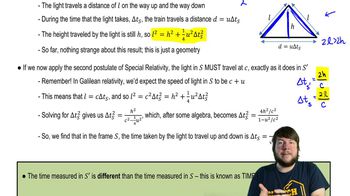
Relative velocity refers to the velocity of one object as observed from another moving object. In special relativity, time dilation occurs when an observer measures time intervals differently due to relative motion, with moving clocks ticking slower compared to stationary ones. This concept is vital for understanding how time and space are perceived differently in the frames S', and S'' as they move at significant fractions of the speed of light.
Recommended video:
Guided course
12:57
Time Dilation