
Ch 25: The Electric Potential
Knight Calc - Physics for Scientists and Engineers 5th Edition
Knight Calc5th EditionPhysics for Scientists and EngineersISBN: 9780137344796Not the one you use?Change textbook
Chapter 25, Problem 60c

Two 10-cm-diameter electrodes 0.50 cm apart form a parallel-plate capacitor. The electrodes are attached by metal wires to the terminals of a 15 V battery. After a long time, the capacitor is disconnected from the battery but is not discharged. What are the charge on each electrode, the electric field strength inside the capacitor, and the potential difference between the electrodes after the original electrodes (not the modified electrodes of part b) are expanded until they are 20 cm in diameter?

Verified step by step guidance
1
Step 1: Understand the problem. The problem involves a parallel-plate capacitor with initial dimensions and voltage. After being disconnected from the battery, the plates are expanded to a new diameter. We need to calculate the charge on each electrode, the electric field strength, and the potential difference after the expansion.
Step 2: Recall the formula for capacitance of a parallel-plate capacitor: C=εA/d, where ε is the permittivity of free space, A is the area of the plates, and d is the separation between the plates. Calculate the initial capacitance using the given diameter and separation.
Step 3: Use the relationship between charge, capacitance, and voltage: Q=CV. Since the capacitor is disconnected from the battery, the charge Q remains constant even after the plates are expanded. Calculate the initial charge using the initial capacitance and voltage.
Step 4: After the plates are expanded, the area A changes, which affects the capacitance. Recalculate the new capacitance using the new diameter and the same separation distance. Use the formula for capacitance again.
Step 5: Determine the new potential difference using the relationship V=QC. Also, calculate the electric field strength inside the capacitor using the formula E=Vd, where d is the separation distance.

Verified video answer for a similar problem:

This video solution was recommended by our tutors as helpful for the problem above.
Was this helpful?

Key Concepts

Here are the essential concepts you must grasp in order to answer the question correctly.

Capacitance

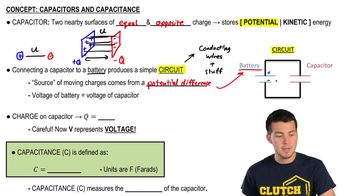
Capacitance is the ability of a system to store electric charge per unit voltage. For parallel-plate capacitors, it is given by the formula C = ε₀(A/d), where ε₀ is the permittivity of free space, A is the area of one plate, and d is the separation between the plates. The larger the area and the smaller the distance between the plates, the greater the capacitance.
Recommended video:
Guided course
08:02
Capacitors & Capacitance (Intro)

Electric Field

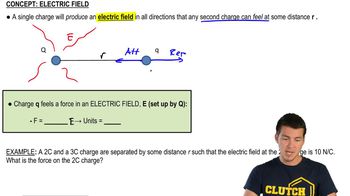
The electric field (E) between the plates of a capacitor is defined as the force per unit charge experienced by a positive test charge placed in the field. For a parallel-plate capacitor, the electric field is uniform and can be calculated using E = V/d, where V is the potential difference and d is the separation between the plates. This field is crucial for understanding how charges interact within the capacitor.
Recommended video:
Guided course
03:16
Intro to Electric Fields

Charge Distribution

When a capacitor is connected to a voltage source, charge accumulates on its plates, creating an electric field. The amount of charge (Q) on each plate is directly proportional to the capacitance and the voltage applied, expressed as Q = C × V. After disconnecting from the battery, the charge remains constant, and any changes in the physical dimensions of the capacitor, such as increasing the plate diameter, will affect the capacitance and electric field strength.
Recommended video:
Guided course
04:03
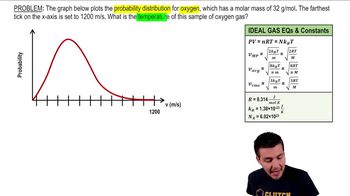
Probability Distribution Graph
Related Practice
Textbook Question

A proton is fired from far away toward the nucleus of an iron atom. Iron is element number 26, and the diameter of the nucleus is 9.0 fm. What initial speed does the proton need to just reach the surface of the nucleus? Assume the nucleus remains at rest.

110
views
Textbook Question

Two spherical drops of mercury each have a charge of 0.10 nC and a potential of 300 V at the surface. The two drops merge to form a single drop. What is the potential at the surface of the new drop?

132
views
Textbook Question

Electrodes of area A are spaced distance d apart to form a parallel-plate capacitor. The electrodes are charged to ±q. What is the infinitesimal increase in electric potential energy dU if an infinitesimal amount of charge dq is moved from the negative electrode to the positive electrode?

141
views
Textbook Question

A 2.0-cm-diameter copper ring has 5.0×10⁹ excess electrons. A proton is released from rest on the axis of the ring, 5.0 cm from its center. What is the proton's speed as it passes through the center of the ring?

134
views
Textbook Question

The potential 1.0 cm from the surface of a metal sphere is 8000 V. The potential 3.0 cm from the surface is 4000 V. What is the radius of the sphere?

142
views
Textbook Question

In the form of radioactive decay known as alpha decay, an unstable nucleus emits a helium-atom nucleus, which is called an alpha particle. An alpha particle contains two protons and two neutrons, thus having mass m=4 u and charge q=2e. Suppose a uranium nucleus with 92 protons decays into thorium, with 90 protons, and an alpha particle. The alpha particle is initially at rest at the surface of the thorium nucleus, which is 15 fm in diameter. What is the speed of the alpha particle when it is detected in the laboratory? Assume the thorium nucleus remains at rest.

112
views