Ch 26: Potential and Field
Knight Calc - Physics for Scientists and Engineers 5th Edition
Knight Calc5th EditionPhysics for Scientists and EngineersISBN: 9780137344796Not the one you use?Change textbook
Chapter 26, Problem 61

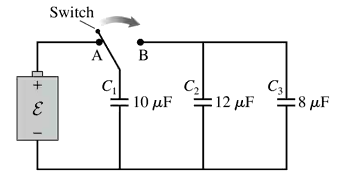
Initially, the switch in FIGURE P26.61 is in position A and capacitors C₂ and C₃ are uncharged. Then the switch is flipped to position B. Afterward, the voltage across C₁ is 4.0 V. What is the emf of the battery?
Circuit diagram showing a switch and three capacitors labeled C₁, C₂, and C₃ with values 10 μF, 12 μF, and 8 μF.

Verified step by step guidance
1
Analyze the circuit configuration: Initially, the switch is in position A, and capacitors C₂ and C₃ are uncharged. When the switch is flipped to position B, the capacitors are connected in a new configuration. Identify how the capacitors are connected (series or parallel) and how the battery interacts with them.
Understand the relationship between voltage and charge for capacitors: The voltage across a capacitor is given by the formula V = Q/C, where Q is the charge and C is the capacitance. Use this formula to relate the voltage across each capacitor to the charge stored on it.
Apply conservation of charge: When the switch is flipped to position B, the charge initially stored on capacitor C₁ is redistributed among capacitors C₂ and C₃. The total charge in the system remains constant. Write an equation to express this conservation of charge.
Use the voltage across C₁ after the switch is flipped: The problem states that the voltage across C₁ is 4.0 V after the switch is flipped. Use this information along with the capacitance values of C₁, C₂, and C₃ to calculate the charge on C₁ and subsequently the charge on C₂ and C₃.
Relate the emf of the battery to the initial charge on C₁: Before the switch is flipped, the battery charges C₁. The emf of the battery is equal to the initial voltage across C₁. Use the relationship between charge, capacitance, and voltage to determine the emf of the battery.

Verified video answer for a similar problem:

This video solution was recommended by our tutors as helpful for the problem above.
Video duration:
9m
Was this helpful?

Key Concepts

Here are the essential concepts you must grasp in order to answer the question correctly.

Capacitance

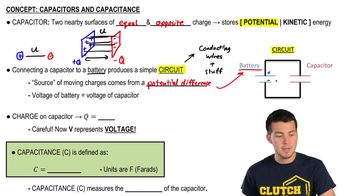
Capacitance is the ability of a capacitor to store charge per unit voltage. It is defined as C = Q/V, where C is capacitance, Q is the charge stored, and V is the voltage across the capacitor. Understanding capacitance is crucial for analyzing how capacitors behave in circuits, especially when they are charged or discharged.
Recommended video:
Guided course
08:02
Capacitors & Capacitance (Intro)

Kirchhoff's Voltage Law

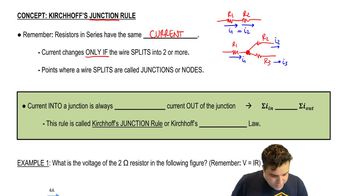
Kirchhoff's Voltage Law states that the sum of the electrical potential differences (voltage) around any closed network is zero. This principle is essential for analyzing circuits, as it allows us to set up equations based on the voltages across components, helping to determine unknown values such as the emf of the battery in this scenario.
Recommended video:
Guided course
04:08
Kirchhoff's Junction Rule

Electromotive Force (emf)

Electromotive force (emf) is the voltage generated by a battery or other source when no current is flowing. It represents the energy provided per unit charge and is a key factor in circuit analysis. In this problem, the emf of the battery can be determined by considering the voltage across the capacitors and applying Kirchhoff's Voltage Law.
Recommended video: