
Ch 28: Fundamentals of Circuits
Knight Calc - Physics for Scientists and Engineers 5th Edition
Knight Calc5th EditionPhysics for Scientists and EngineersISBN: 9780137344796Not the one you use?Change textbook
Chapter 28, Problem 47b

A small toaster that operates at 120 V has a heating element made from a 4.4-m-long, 0.70-mm-diameter nichrome wire. The resistivity, density, and specific heat of nichrome are, respectively, 1.5 x 10⁻⁶ Ωm, 8400 kg/m³, and 450 J/kg K. If half the heat energy is lost to the air, how long does it take the heating element to warm from 20℃ to 450℃, about the temperature at which it first begins to glow red?

Verified step by step guidance
1
Determine the resistance of the nichrome wire using the formula for resistance: R=ρL.

Verified video answer for a similar problem:

This video solution was recommended by our tutors as helpful for the problem above.
Video duration:
13m
Was this helpful?

Key Concepts

Here are the essential concepts you must grasp in order to answer the question correctly.

Ohm's Law

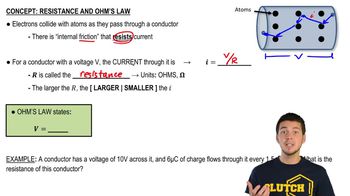
Ohm's Law states that the current flowing through a conductor between two points is directly proportional to the voltage across the two points and inversely proportional to the resistance. This relationship is expressed as V = IR, where V is voltage, I is current, and R is resistance. Understanding this law is crucial for analyzing electrical circuits, such as the toaster's heating element, to determine how much current flows at a given voltage.
Recommended video:
Guided course
03:07
Resistance and Ohm's Law

Heat Transfer and Specific Heat Capacity

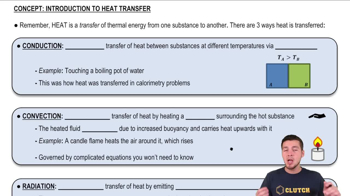
Specific heat capacity is the amount of heat required to raise the temperature of a unit mass of a substance by one degree Celsius. In this context, it helps determine how much energy is needed to heat the nichrome wire from 20℃ to 450℃. Additionally, understanding heat transfer mechanisms, including conduction, convection, and radiation, is essential for calculating energy losses to the surrounding air, which affects the heating time.
Recommended video:
Guided course
05:14
Overview of Heat Transfer

Resistivity and Resistance

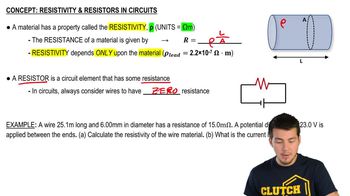
Resistivity is a material property that quantifies how strongly a given material opposes the flow of electric current, expressed in ohm-meters (Ωm). The resistance of a wire can be calculated using the formula R = ρ(L/A), where ρ is resistivity, L is the length of the wire, and A is its cross-sectional area. This concept is vital for determining how much electrical energy is converted into heat in the toaster's heating element, influencing its performance and efficiency.
Recommended video:
Guided course
05:25
Resistivity & Resistors in Circuits