Ch. 19 - Pathogenic Gram-Positive Bacteria
Bauman - Microbiology with Diseases by Taxonomy 6th Edition
Bauman6th EditionMicrobiology with Diseases by TaxonomyISBN: 9780134832302Not the one you use?Change textbook
Chapter 19, Problem 12

Compare and contrast mycoplasmas and viruses.

Verified step by step guidance
1
Step 1: Define mycoplasmas and viruses separately. Mycoplasmas are a group of bacteria characterized by the absence of a cell wall, making them unique among prokaryotes. Viruses are acellular infectious agents composed of genetic material (DNA or RNA) enclosed in a protein coat, and sometimes a lipid envelope.
Step 2: Compare their cellular structure. Mycoplasmas are living cells with a plasma membrane, cytoplasm, ribosomes, and DNA, allowing them to carry out metabolic processes independently. Viruses lack cellular structures and cannot perform metabolic activities on their own; they require a host cell to replicate.
Step 3: Contrast their size and complexity. Mycoplasmas are among the smallest bacteria, typically larger than viruses, and have a more complex cellular organization. Viruses are much smaller, simpler entities, often only containing a few genes necessary for replication.
Step 4: Discuss their reproduction methods. Mycoplasmas reproduce by binary fission, a form of asexual reproduction typical of bacteria. Viruses replicate by hijacking the host cell's machinery to produce viral components, assembling new virus particles inside the host.
Step 5: Summarize their pathogenic roles and treatment implications. Both can cause diseases in humans, but mycoplasmas can be treated with antibiotics targeting bacterial processes, whereas viruses require antiviral drugs or vaccines since antibiotics are ineffective against them.

Verified video answer for a similar problem:

This video solution was recommended by our tutors as helpful for the problem above.
Video duration:
2m
Was this helpful?

Key Concepts

Here are the essential concepts you must grasp in order to answer the question correctly.

Structural Characteristics

Mycoplasmas are the smallest free-living bacteria lacking a cell wall, while viruses are acellular entities composed of genetic material enclosed in a protein coat. Understanding their structural differences is key to distinguishing their biological nature and classification.
Recommended video:
Guided course
05:09
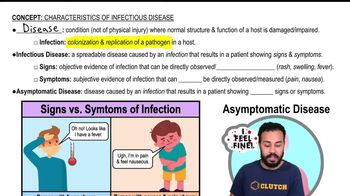
Intro to Characteristics of Infectious Disease

Reproduction and Metabolism

Mycoplasmas reproduce independently through binary fission and have metabolic processes, whereas viruses require a host cell to replicate and lack their own metabolism. This distinction highlights their differing life strategies and dependence on host organisms.
Recommended video:
Guided course
02:17
Introduction to Metabolism

Pathogenicity and Host Interaction

Both mycoplasmas and viruses can cause diseases, but mycoplasmas often cause chronic infections by adhering to host cells, while viruses typically hijack host machinery to produce new viral particles. Their modes of infection and immune evasion differ significantly.
Recommended video:
Guided course
03:40
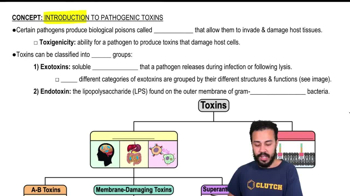
Introduction to Pathogenic Toxins