Ch. 26 - Applied and Industrial Microbiology
Bauman - Microbiology with Diseases by Taxonomy 6th Edition
Bauman6th EditionMicrobiology with Diseases by TaxonomyISBN: 9780134832302Not the one you use?Change textbook
Chapter 26, Problem 5

Biodegradable plastics can be made from which of the following microbial metabolites?
a. Sludge
b. PHB
c. BOD
d. Alum

Verified step by step guidance
1
Understand the question: It asks which microbial metabolite can be used to make biodegradable plastics. Focus on microbial products rather than general substances or chemicals.
Review each option: 'sludge' is a byproduct of wastewater treatment, not a specific microbial metabolite; 'PHB' stands for polyhydroxybutyrate, a well-known microbial polyester; 'BOD' (biochemical oxygen demand) is a measure of organic matter, not a metabolite; 'alum' is a chemical compound used in water treatment, not a microbial product.
Recall that PHB is produced by certain bacteria as an energy storage compound and is biodegradable, making it suitable for producing biodegradable plastics.
Eliminate options that are not microbial metabolites or not related to plastic production, narrowing down to the correct metabolite.
Conclude that the correct answer is the microbial metabolite known for biodegradable plastic production, which is PHB.

Verified video answer for a similar problem:

This video solution was recommended by our tutors as helpful for the problem above.
Video duration:
1m
Was this helpful?

Key Concepts

Here are the essential concepts you must grasp in order to answer the question correctly.

Microbial Metabolites

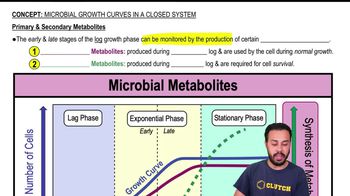
Microbial metabolites are substances produced during the metabolism of microorganisms. These can be primary, essential for growth, or secondary, often with specialized functions. Some metabolites, like polyhydroxyalkanoates, serve as raw materials for biodegradable plastics.
Recommended video:
Guided course
02:33
Primary & Secondary Metabolites

Polyhydroxybutyrate (PHB)

PHB is a type of polyhydroxyalkanoate produced by certain bacteria as an energy storage compound. It is biodegradable and can be processed into bioplastics, making it an eco-friendly alternative to conventional plastics derived from petroleum.

Biodegradable Plastics

Biodegradable plastics are materials that can be broken down by microorganisms into natural substances like water and carbon dioxide. They reduce environmental pollution and are often made from microbial metabolites such as PHB, unlike synthetic plastics which persist in the environment.
Recommended video:
Guided course
02:16
Composition of Item to Be Treated