Ch. 7 - Microbial Genetics
Bauman - Microbiology with Diseases by Taxonomy 6th Edition
Bauman6th EditionMicrobiology with Diseases by TaxonomyISBN: 9780134832302Not the one you use?Change textbook
Chapter 7, Problem 9

Describe how DNA is packaged in both prokaryotes and eukaryotes.

Verified step by step guidance
1
Start by explaining that DNA packaging is essential for fitting the long DNA molecules into the cell and for regulating gene expression.
For prokaryotes, describe that their DNA is typically a single, circular chromosome located in the nucleoid region, and it is compacted by supercoiling and association with nucleoid-associated proteins.
For eukaryotes, explain that DNA is linear and wrapped around histone proteins to form nucleosomes, which further coil and fold into higher-order structures like chromatin fibers and chromosomes.
Highlight the difference that eukaryotic DNA packaging involves multiple levels of organization, including euchromatin (loosely packed, transcriptionally active) and heterochromatin (tightly packed, transcriptionally inactive), whereas prokaryotic DNA packaging is simpler.
Conclude by noting that these packaging strategies reflect the complexity and size differences between prokaryotic and eukaryotic genomes and are crucial for DNA stability and gene regulation.

Verified video answer for a similar problem:

This video solution was recommended by our tutors as helpful for the problem above.
Video duration:
2m
Was this helpful?

Key Concepts

Here are the essential concepts you must grasp in order to answer the question correctly.

DNA Packaging in Prokaryotes

In prokaryotes, DNA is typically organized into a single circular chromosome located in the nucleoid region. The DNA is compacted by supercoiling and binding with nucleoid-associated proteins, which help condense the DNA without a membrane-bound nucleus.
Recommended video:
Guided course
02:42
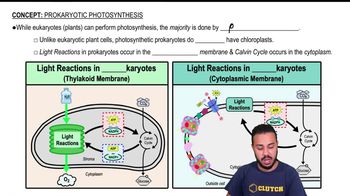
Prokaryotic Photosynthesis

DNA Packaging in Eukaryotes

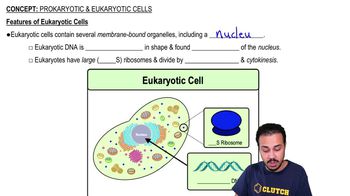
Eukaryotic DNA is linear and packaged within a membrane-bound nucleus. It is wrapped around histone proteins forming nucleosomes, which further coil and fold into higher-order structures like chromatin and chromosomes, allowing efficient compaction and regulation.
Recommended video:
Guided course
04:17
Features of Eukaryotic Cells

Role of Histones and Chromatin Structure

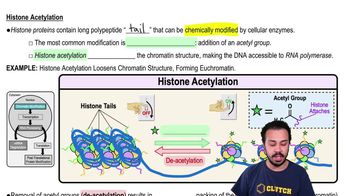
Histones are proteins that DNA wraps around to form nucleosomes, the fundamental units of chromatin. Chromatin structure regulates gene expression and DNA accessibility, with euchromatin being loosely packed and active, and heterochromatin being tightly packed and inactive.
Recommended video:
Guided course
04:14
Histone Acetylation