Ch. 12 - Characterizing and Classifying Eukaryotes
Bauman - Microbiology with Diseases by Taxonomy 6th Edition
Bauman6th EditionMicrobiology with Diseases by TaxonomyISBN: 9780134832302Not the one you use?Change textbook
Chapter 12, Problem 15

Which taxon is characterized by “hairy” flagella?
a. Apicomplexa
b. Euglenozoa
c. Alveolata
d. Stramenopila

Verified step by step guidance
1
Understand that the question asks about a taxon characterized by 'hairy' flagella, which refers to flagella that have fine, hair-like projections called mastigonemes.
Recall that 'hairy' flagella are a distinctive feature of the Stramenopila group, where the flagella have tripartite hairs that increase surface area and aid in movement.
Review the options: Apicomplexa are mostly non-motile or have specialized structures, Euglenozoa have smooth or 'whip-like' flagella, Alveolata includes ciliates and dinoflagellates with different flagellar structures, and Stramenopila are known for their 'hairy' flagella.
Identify that the correct taxon with 'hairy' flagella is Stramenopila based on the characteristic presence of mastigonemes on their flagella.
Conclude that the answer corresponds to option d. Stramenopila.

Verified video answer for a similar problem:

This video solution was recommended by our tutors as helpful for the problem above.
Video duration:
3m
Was this helpful?

Key Concepts

Here are the essential concepts you must grasp in order to answer the question correctly.

Flagella Structure and Types

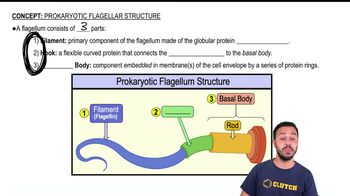
Flagella are whip-like appendages that enable motility in many microorganisms. They can be smooth (whiplash) or have hair-like projections called mastigonemes, which increase surface area and affect movement. Understanding these structural differences helps identify specific taxa.
Recommended video:
Guided course
02:53
Prokaryotic Flagellar Structure

Stramenopila Characteristics

Stramenopila is a diverse group of protists characterized by having two unequal flagella, one of which is 'hairy' with tripartite tubular mastigonemes. This unique flagellar feature distinguishes them from other groups and is key to their identification.
Recommended video:
Guided course
05:09
Intro to Characteristics of Infectious Disease

Taxonomic Groups in Protists

Protist taxonomy includes groups like Apicomplexa, Euglenozoa, Alveolata, and Stramenopila, each with distinct features. Recognizing these groups and their defining traits, such as flagella type or cellular structures, is essential for accurate classification.
Recommended video:
Guided course
06:04
Functional Groups