Ch. 27 - Microbial Ecology and Microbiomes
Bauman - Microbiology with Diseases by Taxonomy 6th Edition
Bauman6th EditionMicrobiology with Diseases by TaxonomyISBN: 9780134832302Not the one you use?Change textbook
Chapter 27, Problem 4

Most chemical elements exist in the environment as:
a. Usable forms in soil and rock
b. Usable forms in water
c. Unusable forms in soil and rock
d. Unusable forms in water

Verified step by step guidance
1
Understand the context: Chemical elements in the environment are often found in forms that are not directly accessible or usable by living organisms.
Recall that many elements are locked in minerals or compounds within soil and rock, making them unavailable for immediate biological use.
Consider the difference between 'usable' and 'unusable' forms: usable forms are those that organisms can readily absorb or metabolize, while unusable forms are chemically bound or inert.
Recognize that most elements are typically found in unusable forms in soil and rock, rather than in water, because water usually contains dissolved ions that are more bioavailable.
Conclude that the correct understanding is that most chemical elements exist in the environment as unusable forms in soil and rock.

Verified video answer for a similar problem:

This video solution was recommended by our tutors as helpful for the problem above.
Video duration:
1m
Was this helpful?

Key Concepts

Here are the essential concepts you must grasp in order to answer the question correctly.

Chemical Element Availability in the Environment

Most chemical elements in nature are found in forms that are not directly usable by organisms. These elements often exist bound in minerals within soil and rock, making them inaccessible until they undergo chemical or biological processes that convert them into usable forms.
Recommended video:
Guided course
03:36
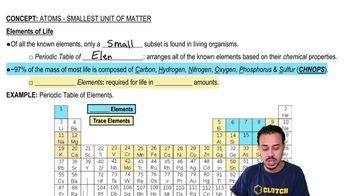
Elements of Life

Role of Soil and Rock in Element Storage

Soil and rock act as reservoirs for many chemical elements, storing them in mineral forms. These minerals are typically insoluble and unavailable to living organisms until weathering or microbial activity releases the elements into more accessible forms.
Recommended video:
Guided course
04:52
Selecting the Right Chemical Agent

Elemental Bioavailability and Environmental Cycling

Bioavailability refers to the extent to which elements can be absorbed and used by organisms. Environmental processes like weathering, microbial metabolism, and water movement transform elements from unusable to usable forms, enabling nutrient cycling essential for life.
Recommended video: