Describe three types of microbes that are extremely resistant to antimicrobial treatment, and explain why they are resistant.
Ch. 9 - Controlling Microbial Growth in the Environment
Bauman6th EditionMicrobiology with Diseases by TaxonomyISBN: 9780134832302Not the one you use?Change textbook
Chapter 9, Problem 2
Which of the following substances or processes kills microorganisms on laboratory surfaces?
a. Antiseptics
b. Disinfectants
c. Degermers
d. Pasteurization
Verified step by step guidance1
Understand the definitions of each option: Antiseptics are chemicals used to reduce or inhibit microbial growth on living tissues, such as skin.
Disinfectants are chemical agents used to destroy or kill microorganisms on inanimate objects and surfaces, such as laboratory benches and equipment.
Degermers are substances or processes that remove microbes mechanically or chemically from living tissues, primarily to reduce microbial load but not necessarily kill all microorganisms.
Pasteurization is a heat treatment process used to reduce microbial load in liquids like milk, but it is not typically used for disinfecting surfaces.
Based on these definitions, identify which option specifically refers to killing microorganisms on laboratory surfaces, focusing on the role of disinfectants.

Verified video answer for a similar problem:
This video solution was recommended by our tutors as helpful for the problem above.
Video duration:
3mWas this helpful?
Key Concepts
Here are the essential concepts you must grasp in order to answer the question correctly.
Disinfectants
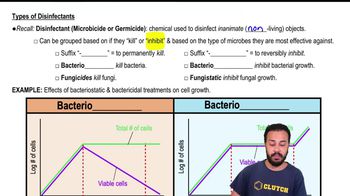
Disinfectants are chemical agents used to destroy or inhibit the growth of microorganisms on inanimate surfaces, such as laboratory benches and equipment. They are stronger than antiseptics and are specifically designed for use on non-living objects to reduce microbial contamination.
Recommended video:
Guided course
Types of Disinfectants
Antiseptics
Antiseptics are substances applied to living tissues, like skin or mucous membranes, to reduce the number of microbes and prevent infection. Unlike disinfectants, they are safe for use on the body but are generally less potent against microorganisms on surfaces.
Recommended video:
Guided course
Biguanides
Pasteurization
Pasteurization is a heat treatment process used to kill pathogenic microorganisms in food and liquids, such as milk, without compromising quality. It is not used for disinfecting surfaces but rather for reducing microbial load in consumables.
Recommended video:
Guided course
Pasteur's Experiments on Spontaneous Generation
Related Practice
Textbook Question
804
views
Textbook Question
Why is it necessary to use strong disinfectants in areas exposed to tuberculosis patients?
729
views
Textbook Question
Compare and contrast four tests that have been developed to measure the effectiveness of disinfectants.
753
views
Textbook Question
Which of the following terms best describes the disinfecting of cafeteria plates?
a. Pasteurization
b. Antisepsis
c. Sterilization
d. Sanitization
827
views
Textbook Question
In practical terms in everyday use, which of the following statements provides the definition of sterilization?
a. Sterilization eliminates all organisms and viruses
b. Sterilization eliminates harmful microorganisms and viruses
c. Sterilization eliminates prions
d. Sterilization eliminates hyperthermophiles
838
views
Textbook Question
Calculate the decimal reduction time (D) for the two temperatures in the following graph.
1276
views