_____ are tumorlike fungal infections.
Ch. 22 - Pathogenic Fungi
Bauman6th EditionMicrobiology with Diseases by TaxonomyISBN: 9780134832302Not the one you use?Change textbook
Chapter 22, Problem 5
Ringworm is caused by a____
a. helminth
b. dermatophyte
c. dimorphic fungus
d. commensal fungus
Verified step by step guidance1
Understand the nature of ringworm: Ringworm is a common skin infection characterized by a ring-shaped rash. It is important to identify the type of organism that causes this infection.
Recall the categories of organisms listed: helminths are parasitic worms, dermatophytes are fungi that infect skin, hair, and nails, dimorphic fungi can exist in two forms (yeast and mold), and commensal fungi normally live on the body without causing disease.
Recognize that ringworm is caused by fungi that specifically infect keratinized tissues such as skin, hair, and nails, which points towards dermatophytes.
Eliminate options: helminths are worms and do not cause ringworm; dimorphic fungi cause other types of infections but not typically ringworm; commensal fungi live harmlessly and do not cause ringworm.
Conclude that the correct answer is dermatophyte, as these fungi are the causative agents of ringworm infections.

Verified video answer for a similar problem:
This video solution was recommended by our tutors as helpful for the problem above.
Video duration:
1mWas this helpful?
Key Concepts
Here are the essential concepts you must grasp in order to answer the question correctly.
Dermatophytes
Dermatophytes are a group of fungi that infect keratinized tissues such as skin, hair, and nails, causing superficial infections like ringworm. They thrive on keratin and are the primary cause of dermatophytosis, which includes conditions like athlete's foot and ringworm.
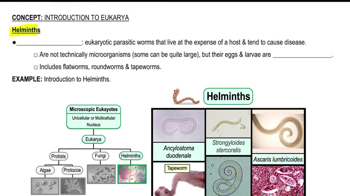
Helminths
Helminths are parasitic worms, including roundworms, tapeworms, and flukes, that infect various body systems. They are multicellular organisms and do not cause fungal infections like ringworm, which is caused by fungi rather than worms.
Recommended video:
Guided course
Helminths
Dimorphic Fungi
Dimorphic fungi can exist in two forms: as molds in the environment and as yeasts in the host. They typically cause systemic or deep fungal infections rather than superficial infections like ringworm, which is caused by dermatophytes.
Recommended video:
Guided course
Fungi
Related Practice
Textbook Question
1170
views
Textbook Question
Which of the following is considered a classical opportunistic fungus?
a. Blastomyces
b. Histoplasma
c. Fonsecaea
d. Aspergillus
1116
views
Textbook Question
How does mycotoxicosis differ from mycetismus?
1249
views
Textbook Question
Indicate whether each statement is true or false. If the statement is false, change the underlined word or phrase to make the statement true.
_____ Sporotrichosis is often caused by introduction of fungi beneath the skin by a thorn prick.
676
views
Textbook Question
Sporotrichosis is caused by the traumatic introduction of ______ into the skin (give genus and species).
1075
views
Textbook Question
Indicate whether each statement is true or false. If the statement is false, change the underlined word or phrase to make the statement true.
_____ Chromoblastomycosis and phaeohyphomycosis are both caused by dark-pigmented ascomycetes.
674
views