Ch. 14 - Infection, Infectious Diseases, and Epidemiology
Bauman - Microbiology with Diseases by Taxonomy 6th Edition
Bauman6th EditionMicrobiology with Diseases by TaxonomyISBN: 9780134832302Not the one you use?Change textbook
Chapter 14, Problem 3

List three portals through which pathogens enter the body.

Verified step by step guidance
1
Understand that a portal of entry is the site through which pathogens enter the host's body to cause infection.
Recall the common portals of entry for pathogens, which are specific anatomical sites or routes.
Identify the respiratory tract as a major portal of entry, where pathogens enter through inhalation into the nose or mouth.
Recognize the gastrointestinal tract as another portal, where pathogens enter through ingestion of contaminated food or water.
Consider the skin and mucous membranes as portals of entry, especially through cuts, abrasions, or direct contact with infected fluids.

Verified video answer for a similar problem:

This video solution was recommended by our tutors as helpful for the problem above.
Video duration:
2m
Was this helpful?

Key Concepts

Here are the essential concepts you must grasp in order to answer the question correctly.

Portals of Entry

Portals of entry are the routes through which pathogens gain access to the host's body. Understanding these portals helps explain how infections begin and spread.
Recommended video:
Guided course
02:29
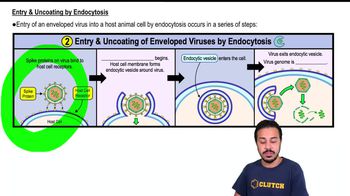
Entry & Uncoating by Endocytosis

Common Portals: Respiratory, Gastrointestinal, and Skin

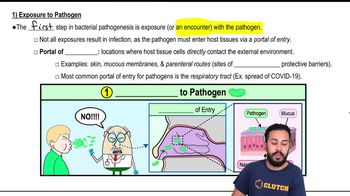
The most common portals include the respiratory tract (via inhalation), the gastrointestinal tract (through ingestion), and the skin (through cuts or abrasions). Each portal provides a unique environment for pathogen entry.
Recommended video:
Guided course
03:27
1) Exposure to Pathogen

Pathogen Adaptations for Entry

Pathogens have evolved specific mechanisms to exploit these portals, such as adhesion molecules to attach to mucous membranes or enzymes to penetrate skin barriers, facilitating successful infection.
Recommended video:
Guided course
03:40
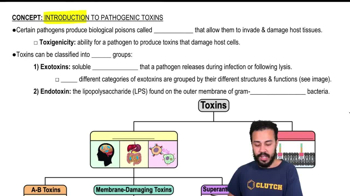
Introduction to Pathogenic Toxins