Ch. 5 - Microbial Metabolism
Bauman - Microbiology with Diseases by Taxonomy 6th Edition
Bauman6th EditionMicrobiology with Diseases by TaxonomyISBN: 9780134832302Not the one you use?Change textbook
Chapter 5, Problem 7

Anaerobic respiration typically uses (organic/inorganic)________ molecules as final electron acceptors.

Verified step by step guidance
1
Understand the concept of anaerobic respiration: it is a type of respiration that occurs in the absence of oxygen, where organisms use molecules other than oxygen as the final electron acceptors in their electron transport chain.
Recall that in aerobic respiration, oxygen (an inorganic molecule) is the final electron acceptor, but in anaerobic respiration, different molecules are used depending on the organism and environment.
Identify the types of molecules used as final electron acceptors in anaerobic respiration, which are typically inorganic molecules such as nitrate (NO\_3\^-), sulfate (SO\_4\^{2-}), or carbon dioxide (CO\_2), rather than organic molecules.
Conclude that anaerobic respiration typically uses inorganic molecules as the final electron acceptors.
Summarize that the blank in the sentence should be filled with 'inorganic' to correctly describe the nature of the final electron acceptors in anaerobic respiration.

Verified video answer for a similar problem:

This video solution was recommended by our tutors as helpful for the problem above.
Video duration:
3m
Was this helpful?

Key Concepts

Here are the essential concepts you must grasp in order to answer the question correctly.

Anaerobic Respiration

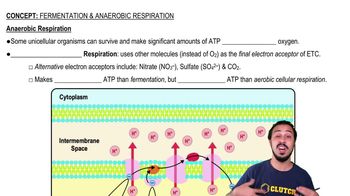
Anaerobic respiration is a type of cellular respiration that occurs without oxygen. Instead of oxygen, other molecules serve as the final electron acceptors in the electron transport chain, allowing cells to generate energy in oxygen-limited environments.
Recommended video:
Guided course
03:35
Anaerobic Respiration

Final Electron Acceptors

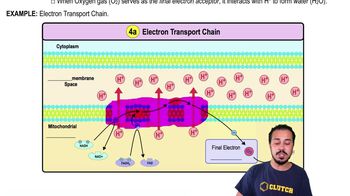
Final electron acceptors are molecules that receive electrons at the end of the electron transport chain during respiration. In anaerobic respiration, these acceptors are typically inorganic molecules such as nitrate, sulfate, or carbon dioxide, unlike oxygen used in aerobic respiration.
Recommended video:
Guided course
07:41
Electron Transport Chain

Organic vs. Inorganic Molecules

Organic molecules contain carbon-hydrogen bonds and are often used as energy sources, while inorganic molecules lack these bonds. In anaerobic respiration, inorganic molecules commonly act as final electron acceptors, distinguishing it from fermentation, which uses organic molecules.
Recommended video:
Guided course
05:22
Scientific Naming of Organisms