Hyperthermophilic prokaryotes may remain viable in canned goods after commercial sterilization. Why is this situation not dangerous to consumers?
Ch. 9 - Controlling Microbial Growth in the Environment
Bauman6th EditionMicrobiology with Diseases by TaxonomyISBN: 9780134832302Not the one you use?Change textbook
Chapter 9, Problem 12
Why are alcohols more effective in a 70% solution than in a 100% solution?
Verified step by step guidance1
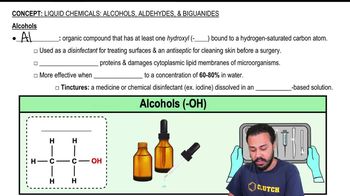
Understand that alcohols, such as ethanol or isopropanol, act as disinfectants primarily by denaturing proteins and disrupting cell membranes of microorganisms.
Recognize that water plays a crucial role in the protein denaturation process because it facilitates the unfolding of proteins, making alcohol more effective at penetrating and disrupting microbial cells.
Note that in a 100% alcohol solution, the lack of water limits the ability of alcohol to denature proteins effectively, as proteins require some water to unfold properly.
In a 70% alcohol solution, the presence of water enhances the penetration of alcohol into the cell and promotes protein denaturation, leading to more efficient microbial killing.
Therefore, the optimal antimicrobial activity of alcohols occurs at around 70% concentration because it balances the presence of alcohol and water to maximize protein denaturation and cell membrane disruption.

Verified video answer for a similar problem:
This video solution was recommended by our tutors as helpful for the problem above.
Video duration:
1mWas this helpful?
Key Concepts
Here are the essential concepts you must grasp in order to answer the question correctly.
Mechanism of Alcohol as a Disinfectant
Alcohols kill microorganisms primarily by denaturing proteins and dissolving lipids in cell membranes, leading to cell lysis. Their effectiveness depends on their ability to penetrate the cell and disrupt vital structures.
Recommended video:
Guided course
Alcohols
Role of Water in Alcohol Solutions
Water is essential in alcohol solutions because it facilitates protein denaturation by helping alcohol penetrate microbial cells more effectively. A 70% alcohol solution contains enough water to slow evaporation and enhance microbial cell penetration.
Recommended video:
Guided course
Alcohols
Evaporation Rate and Contact Time
Pure (100%) alcohol evaporates quickly, reducing contact time with microbes and thus its effectiveness. A 70% solution evaporates more slowly, allowing prolonged exposure and better microbial killing.
Recommended video:
Guided course
Generation Times
Related Practice
Textbook Question
809
views
Textbook Question
Which of the following substances would most effectively inhibit anaerobes?
a. Phenol
b. Silver
c. Ethanol
d. Hydrogen peroxide
697
views
Textbook Question
Which of the following adjectives best describes a surgical procedure that is free of microbial contaminants?
a. Disinfected
b. Sanitized
c. Degermed
d. Aseptic
780
views
Textbook Question
Biosafety Level 3 includes:
a. Double sets of entry doors
b. Pressurized suits
c. Showers in entryways
d. All of the above
670
views
Textbook Question
Contrast the structures and actions of soaps and quats.
732
views
Textbook Question
A sample of E. coli has been subjected to heat for a specified time, and 90% of the cells have been destroyed. Which of the following terms best describes this event?
a. Thermal death point
b. Thermal death time
c. Decimal reduction time
d. None of the above
824
views