
Ch. 15 - Innate Immunity
Bauman - Microbiology with Diseases by Taxonomy 6th Edition
Bauman6th EditionMicrobiology with Diseases by TaxonomyISBN: 9780134832302Not the one you use?Change textbook
Chapter 15, Problem 7

Interferons ____________.
a. Do not protect the cell that secretes them
b. Stimulate the activity of macrophages
c. Cause muscle aches, chills, and fever
d. All of the above

Verified step by step guidance
1
Step 1: Understand what interferons are. Interferons are proteins produced by host cells in response to the presence of pathogens such as viruses, bacteria, or tumor cells. They play a key role in the immune response by interfering with viral replication within host cells.
Step 2: Analyze option (a) 'Do not protect the cell that secretes them.' Interferons are secreted by infected cells but primarily act on neighboring cells to induce antiviral defenses. The secreting cell is often already compromised, so interferons mainly protect surrounding cells rather than the secreting cell itself.
Step 3: Analyze option (b) 'Stimulate the activity of macrophages.' Interferons can enhance the immune response by activating macrophages, which are important phagocytic cells that engulf and destroy pathogens. This is a known function of interferons.
Step 4: Analyze option (c) 'Cause muscle aches, chills, and fever.' Interferons can induce systemic symptoms such as fever, muscle aches, and chills as part of the inflammatory response, which are common side effects during infections or interferon therapy.
Step 5: Combine the information from steps 2, 3, and 4 to evaluate option (d) 'All of the above.' Since all the previous statements about interferons are correct, option (d) is the comprehensive answer.

Verified video answer for a similar problem:

This video solution was recommended by our tutors as helpful for the problem above.
Video duration:
2m
Was this helpful?

Key Concepts

Here are the essential concepts you must grasp in order to answer the question correctly.

Function of Interferons

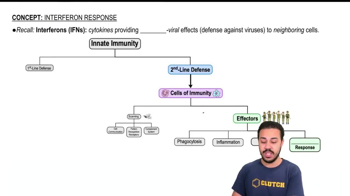
Interferons are signaling proteins released by host cells in response to viral infections. They do not protect the cell that secretes them but instead alert neighboring cells to enhance their antiviral defenses, limiting viral spread.
Recommended video:
Guided course
01:32
Interferon Response

Role of Interferons in Immune Activation

Interferons stimulate immune cells such as macrophages, enhancing their ability to engulf and destroy pathogens. This activation helps coordinate the innate immune response against infections.
Recommended video:
Guided course
01:32
Interferon Response

Interferons and Inflammatory Symptoms

Interferons can induce systemic effects like muscle aches, chills, and fever by triggering inflammatory pathways. These symptoms are part of the body's response to infection and help inhibit pathogen replication.
Recommended video:
Guided course
01:32
Interferon Response