Ch. 10 - Controlling Microbial Growth in the Body: Antimicrobial Drugs
Bauman - Microbiology with Diseases by Taxonomy 6th Edition
Bauman6th EditionMicrobiology with Diseases by TaxonomyISBN: 9780134832302Not the one you use?Change textbook
Chapter 10, Problem 5

Support or refute the following statement: Antimicrobial agents make cells become resistant.

Verified step by step guidance
1
Step 1: Understand the statement by defining key terms: 'antimicrobial agents' are substances that kill or inhibit the growth of microorganisms, and 'resistance' refers to the ability of microorganisms to survive and multiply despite the presence of antimicrobial agents.
Step 2: Clarify that antimicrobial agents themselves do not cause cells to become resistant directly; rather, resistance arises through genetic changes in microorganisms, such as mutations or acquisition of resistance genes via horizontal gene transfer.
Step 3: Explain the role of selective pressure: when antimicrobial agents are used, they kill susceptible microbes but allow resistant ones to survive and multiply, leading to an increase in the proportion of resistant cells in the population.
Step 4: Discuss that improper or excessive use of antimicrobial agents accelerates this selection process, promoting the spread of resistance, but the agents do not induce resistance mechanisms by themselves.
Step 5: Conclude that antimicrobial agents select for resistant cells rather than making cells resistant, so the statement is not accurate as written.

Verified video answer for a similar problem:

This video solution was recommended by our tutors as helpful for the problem above.
Video duration:
3m
Was this helpful?

Key Concepts

Here are the essential concepts you must grasp in order to answer the question correctly.

Mechanism of Action of Antimicrobial Agents

Antimicrobial agents target specific structures or functions in microbial cells, such as cell walls, protein synthesis, or DNA replication, to inhibit growth or kill the microbes. Understanding how these agents work is essential to grasp their effects on microbial populations.
Recommended video:
Guided course
02:43
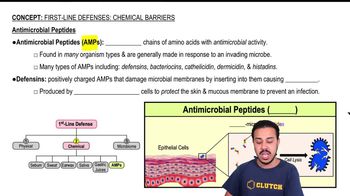
Antimicrobial Peptides

Development of Antimicrobial Resistance

Resistance arises when microbes acquire genetic changes that reduce the effectiveness of antimicrobial agents, often through mutation or horizontal gene transfer. This process is driven by selective pressure, where susceptible cells are killed and resistant ones survive and multiply.
Recommended video:
Guided course
02:43
Antimicrobial Peptides

Difference Between Resistance and Induced Resistance

Antimicrobial agents do not cause cells to become resistant directly; rather, they select for pre-existing resistant variants. Resistance is not induced by the drug but is a result of natural selection acting on genetic diversity within microbial populations.
Recommended video:
Guided course
06:20
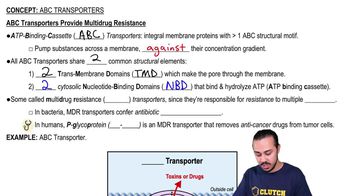
ABC Transporters Provide Multidrug Resistance
Related Practice
Textbook Question

Given that resistant strains of pathogens are a concern to the general health of a population, what can be done to prevent their development?

1201
views

Textbook Question

Given that both human cells and pathogens synthesize proteins at ribosomal sites, how can antimicrobial agents that target this process be safe to use in humans?

760
views
Textbook Question

Multiple-drug-resistant microbes _____________________  .

a. Are resistant to all antimicrobial agents

b. Respond to new antimicrobials by developing resistance

c. Frequently develop in hospitals

d. All of the above

732
views
Textbook Question

Which of the following statements is relevant in explaining why sulfonamides are effective?

a. Sulfonamides attach to sterol lipids in the pathogen, disrupt the membranes, and lyse the cells.

b. Sulfonamides prevent the incorporation of amino acids into polypeptide chains.

c. Humans and microbes use PABA differently in their metabolism.

d. Sulfonamides inhibit DNA replication in both pathogens and human cells.

712
views
Textbook Question

Cross resistance is __________ .

a. The deactivation of an antimicrobial agent by a bacterial enzyme

b. Alteration of the resistant cells so that an antimicrobial agent cannot attach

c. The mutation of genes that affect the cytoplasmic membrane channels so that antimicrobial agents cannot cross into the cell’s interior

d. Resistance to one antimicrobial agent because of its similarity to another antimicrobial agent

759
views
Textbook Question

The key to successful chemotherapy is __________ .

a. Selective toxicity

b. A diffusion test

c. The minimum inhibitory concentration test

d. The spectrum of action

861
views