Ch. 1 - A Brief History of Microbiology
Bauman - Microbiology with Diseases by Taxonomy 6th Edition
Bauman6th EditionMicrobiology with Diseases by TaxonomyISBN: 9780134832302Not the one you use?Change textbook
Chapter 1, Problem 8

Refer to the four steps in the scientific method in describing Pasteur’s fermentation experiments.

Verified step by step guidance
1
Step 1: Observation - Pasteur observed that fermentation was associated with the presence of living microorganisms, such as yeast, and that different microbes produced different fermentation products.
Step 2: Hypothesis - He hypothesized that fermentation is a biological process carried out by specific microorganisms rather than a purely chemical process.
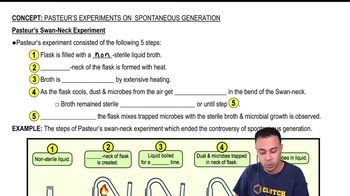
Step 3: Experiment - Pasteur designed experiments using swan-neck flasks to show that sterilized broth remained free of microbial growth unless exposed to microorganisms from the air, demonstrating that microbes are responsible for fermentation.
Step 4: Conclusion - From his experiments, Pasteur concluded that fermentation depends on living microorganisms, disproving the idea of spontaneous generation and establishing the biological basis of fermentation.

Verified video answer for a similar problem:

This video solution was recommended by our tutors as helpful for the problem above.
Video duration:
2m
Was this helpful?

Key Concepts

Here are the essential concepts you must grasp in order to answer the question correctly.

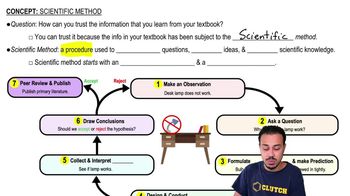
The Scientific Method

The scientific method is a systematic approach to inquiry involving observation, hypothesis formulation, experimentation, and conclusion. It ensures that scientific investigations are structured and reproducible, allowing researchers to test ideas and validate results objectively.
Recommended video:
Guided course
06:29
Scientific Method

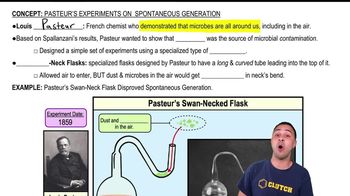
Pasteur’s Fermentation Experiments

Louis Pasteur’s fermentation experiments demonstrated that microorganisms are responsible for fermentation, disproving spontaneous generation. He used sterilized broth and swan-neck flasks to show that microbial contamination, not air alone, caused fermentation and spoilage.
Recommended video:
Guided course
03:53
Pasteur's Experiments on Spontaneous Generation

Application of the Four Steps in Pasteur’s Work

Pasteur applied the scientific method by observing fermentation, hypothesizing microbes caused it, designing experiments with controlled conditions, and concluding that specific microbes produce fermentation. This approach validated germ theory and advanced microbiology.
Recommended video:
Guided course
05:58
Pasteur’s Swan-Neck Experiment