Ch. 2 - Chemical Principles
Tortora - Microbiology: An Introduction 14th Edition
Tortora14th EditionMicrobiology: An IntroductionISBN: 9780138200398Not the one you use?Change textbook
Chapter 2, Problem 9

Draw a simple lipid, and show how it could be modified to a phospholipid.

Verified step by step guidance
1
Step 1: Begin by drawing a simple lipid, which typically consists of a glycerol backbone attached to three fatty acid chains. Represent the glycerol as a three-carbon molecule, with each carbon connected to a fatty acid chain via an ester bond.
Step 2: To modify this simple lipid into a phospholipid, replace one of the fatty acid chains with a phosphate group. This means that instead of three fatty acids, the glycerol backbone will have two fatty acids and one phosphate group attached.
Step 3: Draw the phosphate group attached to the third carbon of the glycerol backbone. The phosphate group is often represented as a phosphorus atom bonded to four oxygen atoms, one of which connects to the glycerol.
Step 4: Optionally, add a polar head group attached to the phosphate group, such as choline, serine, or ethanolamine. This head group gives the phospholipid its amphipathic properties, with a hydrophilic (water-attracting) head and hydrophobic (water-repelling) tails.
Step 5: Label the hydrophobic fatty acid tails and the hydrophilic phosphate head group to emphasize the structural difference between a simple lipid (triacylglycerol) and a phospholipid.

Verified video answer for a similar problem:

This video solution was recommended by our tutors as helpful for the problem above.
Video duration:
2m
Was this helpful?

Key Concepts

Here are the essential concepts you must grasp in order to answer the question correctly.

Structure of Simple Lipids

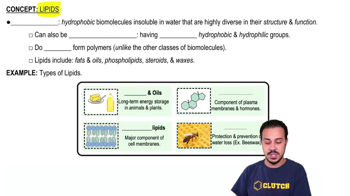
Simple lipids, such as triglycerides, consist of a glycerol backbone bonded to three fatty acid chains. These hydrophobic molecules serve primarily as energy storage and are nonpolar, lacking any charged groups.
Recommended video:

Phospholipid Composition

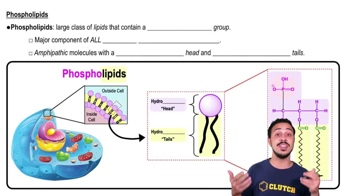
Phospholipids are modified lipids where one fatty acid in a triglyceride is replaced by a phosphate group linked to a polar head. This amphipathic structure has a hydrophilic (water-attracting) head and hydrophobic tails, essential for forming cell membranes.
Recommended video:
Guided course
04:05
Phospholipids

Modification from Simple Lipid to Phospholipid

To convert a simple lipid into a phospholipid, one fatty acid chain is removed and replaced with a phosphate group attached to an additional polar molecule. This modification imparts polarity, enabling the molecule to form bilayers critical for membrane structure.
Recommended video:
Guided course
04:05
Phospholipids