Ch. 7 - Microbial Genetics
Bauman - Microbiology with Diseases by Taxonomy 6th Edition
Bauman6th EditionMicrobiology with Diseases by TaxonomyISBN: 9780134832302Not the one you use?Change textbook
Chapter 7, Problem 9

__________ are nucleotide sequences containing palindromes and genes for proteins that cut DNA strands.

Verified step by step guidance
1
Identify the key components described in the problem: nucleotide sequences containing palindromes and genes for proteins that cut DNA strands.
Recall that palindromic sequences in DNA are sequences that read the same 5' to 3' on one strand and 5' to 3' on the complementary strand, which are recognized by specific enzymes.
Understand that the proteins which cut DNA strands at or near these palindromic sequences are called restriction enzymes or restriction endonucleases.
Recognize that the nucleotide sequences containing these palindromic sites and the genes encoding the restriction enzymes together form what is known as a restriction-modification system.
Conclude that the term describing these nucleotide sequences with palindromes and genes for cutting proteins is 'restriction sites' or more broadly, 'restriction enzymes' and their corresponding recognition sequences.

Verified video answer for a similar problem:

This video solution was recommended by our tutors as helpful for the problem above.
Video duration:
2m
Was this helpful?

Key Concepts

Here are the essential concepts you must grasp in order to answer the question correctly.

Restriction Enzymes (Restriction Endonucleases)

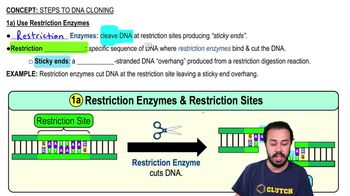
Restriction enzymes are proteins that recognize specific nucleotide sequences in DNA, often palindromic, and cut the DNA at or near these sites. They are essential tools in molecular biology for DNA manipulation and cloning.
Recommended video:
Guided course
03:27
1a) Use Restriction Enzymes

Palindromic DNA Sequences

Palindromic sequences in DNA are regions where the sequence of nucleotides reads the same forward and backward on complementary strands. These sequences are the recognition sites for many restriction enzymes.
Recommended video:
Guided course
02:13
Introduction to DNA Sequencing

Restriction Sites and Genes Encoding Restriction Enzymes

Restriction sites are specific DNA sequences recognized and cut by restriction enzymes. The genes encoding these enzymes are often found in bacterial genomes as part of restriction-modification systems that protect bacteria from foreign DNA.
Recommended video:
Guided course
03:27
1a) Use Restriction Enzymes