Ch. 17 - Immunization and Immune Testing
Bauman - Microbiology with Diseases by Taxonomy 6th Edition
Bauman6th EditionMicrobiology with Diseases by TaxonomyISBN: 9780134832302Not the one you use?Change textbook
Chapter 17, Problem 5

Explain how a pregnancy test works at the molecular level.

Verified step by step guidance
1
Understand that a pregnancy test detects the presence of the hormone human chorionic gonadotropin (hCG) in urine, which is produced shortly after a fertilized egg attaches to the uterine lining.
Recognize that the test strip contains antibodies that specifically bind to hCG molecules; these antibodies are usually linked to a color-producing enzyme or a colored particle like colloidal gold.
When urine is applied to the test strip, any hCG present binds to the labeled antibodies, forming an antibody-hCG complex that migrates along the strip by capillary action.
The complex reaches a test line where immobilized antibodies capture the hCG-antibody complex, causing the accumulation of the colored label and producing a visible line indicating a positive result.
A control line further along the strip contains antibodies that bind the labeled antibodies regardless of hCG presence, confirming that the test is working properly.

Verified video answer for a similar problem:

This video solution was recommended by our tutors as helpful for the problem above.
Video duration:
2m
Was this helpful?

Key Concepts

Here are the essential concepts you must grasp in order to answer the question correctly.

Human Chorionic Gonadotropin (hCG)

hCG is a hormone produced by the placenta shortly after embryo implantation. Its presence in urine or blood is the key indicator of pregnancy, as it is not normally found in significant amounts in non-pregnant individuals.
Recommended video:
Guided course
03:25
The Human Microbiome

Antigen-Antibody Interaction

Pregnancy tests use antibodies that specifically bind to hCG molecules. This antigen-antibody binding is highly selective, allowing the test to detect even low levels of hCG with high specificity.
Recommended video:
Guided course
09:16
Outcomes of Antibody Binding to Antigen

Immunochromatographic Assay Mechanism

Most pregnancy tests use a lateral flow immunoassay where urine moves along a strip, carrying hCG to bind with labeled antibodies. This complex migrates to a test line where immobilized antibodies capture it, producing a visible colored line indicating a positive result.
Recommended video:
Guided course
04:21
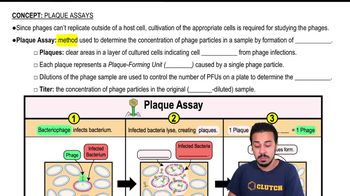
Plaque Assays