Why is it necessary to use strong disinfectants in areas exposed to tuberculosis patients?
Ch. 9 - Controlling Microbial Growth in the Environment
Bauman6th EditionMicrobiology with Diseases by TaxonomyISBN: 9780134832302Not the one you use?Change textbook
Chapter 9, Problem 4
Why do warm disinfectant chemicals generally work better than cool ones?
Verified step by step guidance1
Understand that disinfectants work by disrupting microbial cells through chemical reactions, which are influenced by temperature.
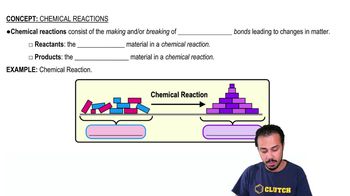
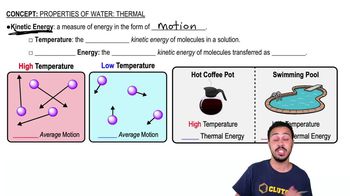
Recognize that increasing temperature generally increases the kinetic energy of molecules, leading to faster chemical reactions between the disinfectant and microbial components.
Consider that warmer temperatures can enhance the permeability of microbial cell membranes, allowing disinfectants to penetrate cells more effectively.
Note that some disinfectants may become more soluble or active at higher temperatures, improving their ability to interact with and destroy microbes.
Conclude that warm disinfectants work better because the increased temperature accelerates the chemical activity and microbial susceptibility, leading to more efficient disinfection.

Verified video answer for a similar problem:
This video solution was recommended by our tutors as helpful for the problem above.
Video duration:
1mWas this helpful?
Key Concepts
Here are the essential concepts you must grasp in order to answer the question correctly.
Effect of Temperature on Chemical Reaction Rates
Increasing temperature generally speeds up chemical reactions by providing molecules with more kinetic energy, leading to more frequent and effective collisions. This principle explains why warm disinfectants act faster and more efficiently than cool ones.
Recommended video:
Guided course
Chemical Reactions
Mechanism of Disinfectants
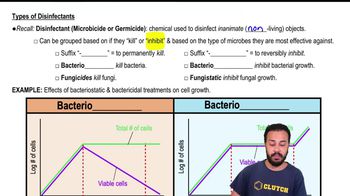
Disinfectants kill or inhibit microorganisms by disrupting cell membranes, denaturing proteins, or interfering with metabolic processes. Higher temperatures can enhance these effects by increasing the permeability of microbial cells and accelerating chemical interactions.
Recommended video:
Guided course
Types of Disinfectants
Thermal Stability of Microorganisms
Many microorganisms are sensitive to heat, which can weaken their structures and defenses. Warm disinfectants exploit this vulnerability, making microbes more susceptible to chemical attack compared to when disinfectants are applied at cooler temperatures.
Recommended video:
Guided course
Properties of Water- Thermal
Related Practice
Textbook Question
729
views
Textbook Question
The microbial death rate is used to measure the effectiveness of:
a. A detergent
b. An antiseptic
c. Sanitization techniques
d. All of the above
941
views
Textbook Question
Why are Gram-negative bacteria more susceptible to heat than Gram-positive bacteria?
1402
views
Textbook Question
Compare and contrast four tests that have been developed to measure the effectiveness of disinfectants.
753
views
Textbook Question
Which of the following terms best describes the disinfecting of cafeteria plates?
a. Pasteurization
b. Antisepsis
c. Sterilization
d. Sanitization
827
views
Textbook Question
Which of the following statements is true concerning the selection of an antimicrobial agent?
a. An ideal antimicrobial agent is stable during storage
b. An ideal antimicrobial agent is fast acting
c. Ideal microbial agents do not exist
d. All of the above are correct
745
views