
Ch. 12 - Characterizing and Classifying Eukaryotes
Bauman - Microbiology with Diseases by Taxonomy 6th Edition
Bauman6th EditionMicrobiology with Diseases by TaxonomyISBN: 9780134832302Not the one you use?Change textbook
Chapter 12, Problem 2

How do fungi acquire nutrients?

Verified step by step guidance
1
Understand that fungi acquire nutrients through a process called absorptive nutrition, which means they secrete enzymes outside their bodies to break down complex organic matter into simpler compounds.
Recognize that fungi release extracellular enzymes such as cellulases, proteases, and lipases to degrade substances like cellulose, proteins, and lipids in their environment.
Note that after enzymatic breakdown, fungi absorb the resulting small molecules (like sugars, amino acids, and fatty acids) through their cell walls and membranes.
Remember that fungi are heterotrophic organisms, meaning they cannot produce their own food via photosynthesis and rely on external organic material for nutrition.
Identify that fungi can be saprophytic (feeding on dead organic matter), parasitic (feeding on living hosts), or mutualistic (engaging in symbiotic relationships) in their nutrient acquisition strategies.

Verified video answer for a similar problem:

This video solution was recommended by our tutors as helpful for the problem above.
Video duration:
2m
Was this helpful?

Key Concepts

Here are the essential concepts you must grasp in order to answer the question correctly.

Saprotrophic Nutrition

Fungi primarily acquire nutrients through saprotrophic nutrition, where they secrete enzymes to break down dead organic matter externally and then absorb the simpler nutrients. This process allows fungi to decompose complex substances like cellulose and lignin.
Recommended video:
Guided course
05:58
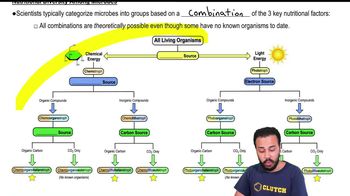
Nutritional Diversity Among Microbes

Absorptive Nutrition

Fungi absorb nutrients directly through their cell walls after extracellular digestion. Their hyphae increase surface area, facilitating efficient uptake of dissolved organic compounds from their environment.
Recommended video:
Guided course
05:58
Nutritional Diversity Among Microbes

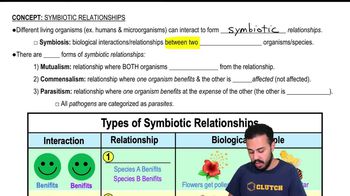
Parasitic and Symbiotic Relationships

Some fungi obtain nutrients by forming parasitic or symbiotic relationships. Parasitic fungi extract nutrients from living hosts, often harming them, while symbiotic fungi, like mycorrhizae, exchange nutrients mutually with plants.
Recommended video:
Guided course
05:59
Symbiotic Relationships