
Ch. 7 - Microbial Genetics
Bauman - Microbiology with Diseases by Taxonomy 6th Edition
Bauman6th EditionMicrobiology with Diseases by TaxonomyISBN: 9780134832302Not the one you use?Change textbook
Chapter 7, Problem 4

Insertions and deletions in the genetic code are also called ___________ mutations.

Verified step by step guidance
1
Understand the types of mutations in genetics: point mutations, insertions, deletions, and frameshift mutations.
Recall that insertions and deletions involve adding or removing nucleotides from the DNA sequence.
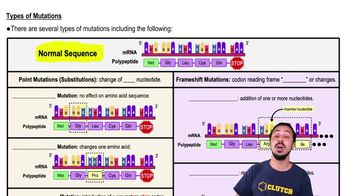
Recognize that when insertions or deletions are not in multiples of three nucleotides, they shift the reading frame of the genetic code.
Identify that this shift in the reading frame is specifically called a frameshift mutation.
Conclude that insertions and deletions in the genetic code are also called frameshift mutations.

Verified video answer for a similar problem:

This video solution was recommended by our tutors as helpful for the problem above.
Video duration:
1m
Was this helpful?

Key Concepts

Here are the essential concepts you must grasp in order to answer the question correctly.

Types of Genetic Mutations

Genetic mutations are changes in the DNA sequence and include substitutions, insertions, and deletions. Insertions add extra nucleotides, while deletions remove them, both potentially altering the genetic code significantly.
Recommended video:
Guided course
08:44
Types of Mutations

Frameshift Mutations

Insertions and deletions that are not in multiples of three nucleotides cause frameshift mutations. These shift the reading frame of the genetic code, often resulting in completely different and nonfunctional proteins.
Recommended video:
Guided course
08:44
Types of Mutations

Impact of Mutations on Protein Synthesis

Mutations can affect protein synthesis by changing the mRNA sequence, which alters the amino acid sequence during translation. Frameshift mutations typically lead to premature stop codons or dysfunctional proteins, impacting cellular function.
Recommended video:
Guided course
00:37
Introduction to Mutations