Ch. 7 - Microbial Genetics
Bauman - Microbiology with Diseases by Taxonomy 6th Edition
Bauman6th EditionMicrobiology with Diseases by TaxonomyISBN: 9780134832302Not the one you use?Change textbook
Chapter 7, Problem 7

Besides the fact that it synthesizes RNA, how does RNA polymerase differ in function from DNA polymerase?

Verified step by step guidance
1
Step 1: Understand the primary function of RNA polymerase, which is to synthesize RNA molecules by reading a DNA template during the process called transcription.
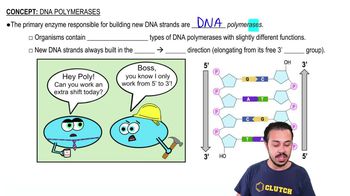
Step 2: Recognize that DNA polymerase synthesizes DNA molecules by adding nucleotides to a pre-existing DNA strand during DNA replication.
Step 3: Note that RNA polymerase can initiate RNA synthesis de novo, meaning it does not require a primer to start adding nucleotides, whereas DNA polymerase requires a primer to begin DNA synthesis.
Step 4: Consider the substrate differences: RNA polymerase uses ribonucleoside triphosphates (rNTPs) as substrates, while DNA polymerase uses deoxyribonucleoside triphosphates (dNTPs).
Step 5: Summarize that RNA polymerase is involved in transcription producing RNA from DNA, can start synthesis without a primer, and uses rNTPs, whereas DNA polymerase is involved in DNA replication, requires a primer, and uses dNTPs.

Verified video answer for a similar problem:

This video solution was recommended by our tutors as helpful for the problem above.
Video duration:
3m
Was this helpful?

Key Concepts

Here are the essential concepts you must grasp in order to answer the question correctly.

Function of RNA Polymerase

RNA polymerase is an enzyme that synthesizes RNA by reading a DNA template strand during transcription. It initiates RNA synthesis without needing a primer and adds ribonucleotides complementary to the DNA template, producing a single-stranded RNA molecule.
Recommended video:
Guided course
04:01
DNA Polymerases

Function of DNA Polymerase

DNA polymerase synthesizes DNA by adding deoxyribonucleotides to a pre-existing primer strand during DNA replication. It requires a primer to start and ensures high fidelity by proofreading newly synthesized DNA strands to minimize errors.
Recommended video:
Guided course
04:01
DNA Polymerases

Primer Requirement and Proofreading Differences

Unlike DNA polymerase, RNA polymerase does not require a primer to begin synthesis, allowing it to start RNA chains de novo. Additionally, RNA polymerase generally lacks proofreading ability, resulting in a higher error rate compared to DNA polymerase, which has proofreading functions to maintain DNA integrity.
Recommended video:
Guided course
05:32
Reviewing the Different Types of Microscopes