
Ch. 8 - Recombinant DNA Technology
Bauman - Microbiology with Diseases by Taxonomy 6th Edition
Bauman6th EditionMicrobiology with Diseases by TaxonomyISBN: 9780134832302Not the one you use?Change textbook
Chapter 8, Problem 3

Describe three ways scientists use synthetic nucleic acids.

Verified step by step guidance
1
Understand that synthetic nucleic acids are artificially created sequences of DNA or RNA used in various scientific applications.
First, recognize that one common use is in molecular cloning, where synthetic nucleic acids serve as primers or probes to amplify or detect specific DNA sequences.
Second, synthetic nucleic acids are used in gene synthesis, allowing scientists to create custom genes or modify existing ones for research or therapeutic purposes.
Third, they are employed in antisense technology or RNA interference, where synthetic nucleic acids bind to target mRNA to regulate gene expression or silence specific genes.
Summarize these uses by explaining how synthetic nucleic acids enable precise manipulation and study of genetic material in research, diagnostics, and treatment development.

Verified video answer for a similar problem:

This video solution was recommended by our tutors as helpful for the problem above.
Video duration:
3m
Was this helpful?

Key Concepts

Here are the essential concepts you must grasp in order to answer the question correctly.

Synthetic Nucleic Acids

Synthetic nucleic acids are artificially created DNA or RNA molecules designed to mimic or modify natural genetic material. They can be chemically synthesized with specific sequences, allowing precise control over their structure and function for research and therapeutic purposes.
Recommended video:
Guided course
03:22
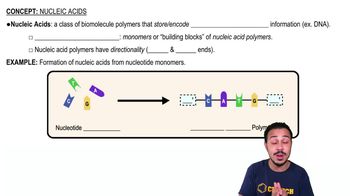
Nucleic Acids

Gene Editing and Therapy

Scientists use synthetic nucleic acids in gene editing techniques, such as CRISPR, to target and modify specific genes. Synthetic guide RNAs or DNA templates help correct genetic mutations or introduce new traits, offering potential treatments for genetic diseases.
Recommended video:
Guided course
04:42
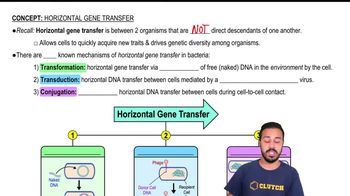
Horizontal Gene Transfer

Molecular Probes and Diagnostics

Synthetic nucleic acids serve as molecular probes in diagnostic tests by binding to complementary sequences in pathogens or cells. This enables detection of specific DNA or RNA sequences, facilitating disease diagnosis, pathogen identification, and monitoring of gene expression.
Recommended video:
Guided course
03:20
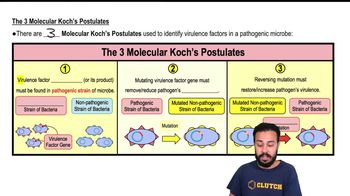
The 3 Molecular Koch's Postulates
Related Practice
Textbook Question

Indicate which of the following are true and which are false. Rewrite any false statements to make them true by changing the underlined words.

__________ A thermocycler separates molecules based on their size, shape, and electrical charge.

806
views
Textbook Question

Indicate which of the following are true and which are false. Rewrite any false statements to make them true by changing the underlined words.

__________ Protoplast fusion is often used in the genetic modification of plants.

760
views
Textbook Question

Indicate which of the following are true and which are false. Rewrite any false statements to make them true by changing the underlined words.

__________ Restriction enzymes act at specific nucleotide sequences within a double-stranded DNA molecule.

683
views
Textbook Question

After scientists exposed cultures of Penicillium to agents X, Y, and Z, they examined the type and amount of penicillin produced by the altered fungi to find the one that is most effective. Agents X, Y, and Z were probably __________ .


a. recombinant cells

b. competent

c. mutagens

d. phages

1356
views
Textbook Question

A DNA gene synthesized from an RNA template is ___________ .


a. reverse transcriptase

b. complementary DNA

c. recombinant DNA

d. probe DNA

1434
views
Textbook Question

Which of the following is false concerning vectors in recombinant DNA technology?


a. Vectors are small enough to manipulate outside a cell.

b. Vectors contain a recognizable genetic marker.

c. Vectors survive inside cells.

d. Vectors must contain genes for self-replication.

1277
views