Ch. 12 - Characterizing and Classifying Eukaryotes
Bauman - Microbiology with Diseases by Taxonomy 6th Edition
Bauman6th EditionMicrobiology with Diseases by TaxonomyISBN: 9780134832302Not the one you use?Change textbook
Chapter 12, Problem 5

Amoebas with stiff pseudopods and silica shells are ___________.

Verified step by step guidance
1
Identify the key characteristics described: amoebas with stiff pseudopods and silica shells.
Recall that pseudopods are extensions of the cell used for movement and feeding, and their stiffness can indicate a specific group of amoebas.
Understand that silica shells refer to a hard, protective outer covering made of silicon dioxide, which is a distinctive feature.
Connect these features to known groups of amoebas; those with stiff pseudopods and silica shells belong to the group called 'Radiolarians'.
Conclude that the blank should be filled with 'Radiolarians', as they are amoebas characterized by stiff pseudopods and silica-based skeletons.

Verified video answer for a similar problem:

This video solution was recommended by our tutors as helpful for the problem above.
Video duration:
2m
Was this helpful?

Key Concepts

Here are the essential concepts you must grasp in order to answer the question correctly.

Amoebas and Pseudopods

Amoebas are single-celled protists that move and feed using extensions called pseudopods. These pseudopods are temporary projections of the cell's cytoplasm, which can be flexible or stiff depending on the species, aiding in locomotion and capturing food.
Recommended video:
Guided course
02:24
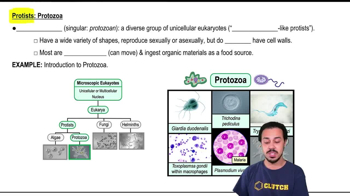
Protists:Protozoa

Silica Shells in Protists

Some protists produce protective outer coverings made of silica, a hard, glass-like substance. These silica shells provide structural support and protection, and are characteristic of certain groups like diatoms and radiolarians.
Recommended video:
Guided course
09:44
Electron Orbitals & Energy Shells

Heliozoans

Heliozoans are a group of amoeboid protists known for their stiff, radiating pseudopods and silica-based skeletons. They use these stiff pseudopods for capturing prey and maintaining shape, distinguishing them from other amoebas with flexible pseudopods.