
Ch. 7 - Microbial Genetics
Bauman - Microbiology with Diseases by Taxonomy 6th Edition
Bauman6th EditionMicrobiology with Diseases by TaxonomyISBN: 9780134832302Not the one you use?Change textbook
Chapter 7, Problem 6

Which of the following molecules functions as a “proofreader” for a newly replicated strand of DNA?
a. DNA polymerase III
b. Primase
c. Helicase
d. Ligase

Verified step by step guidance
1
Understand the role of each enzyme listed in the options during DNA replication.
Recall that DNA polymerase III is the main enzyme responsible for synthesizing the new DNA strand by adding nucleotides complementary to the template strand.
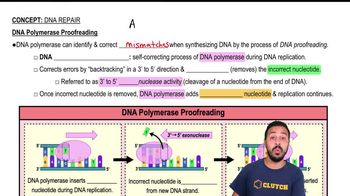
Recognize that DNA polymerase III also has a 3' to 5' exonuclease activity, which allows it to remove incorrectly paired nucleotides immediately after they are added, effectively acting as a 'proofreader'.
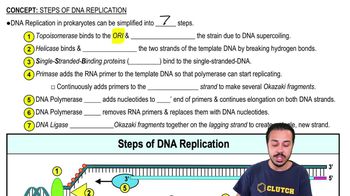
Know that primase synthesizes RNA primers to initiate DNA synthesis, helicase unwinds the DNA double helix, and ligase joins Okazaki fragments on the lagging strand, but none of these have proofreading functions.
Conclude that the molecule functioning as a 'proofreader' is DNA polymerase III due to its exonuclease proofreading activity.

Verified video answer for a similar problem:

This video solution was recommended by our tutors as helpful for the problem above.
Video duration:
1m
Was this helpful?

Key Concepts

Here are the essential concepts you must grasp in order to answer the question correctly.

DNA Polymerase III and Proofreading

DNA Polymerase III is the primary enzyme responsible for synthesizing new DNA strands during replication. It also has a proofreading function through its 3' to 5' exonuclease activity, which allows it to remove incorrectly paired nucleotides, ensuring high fidelity in DNA replication.
Recommended video:
Guided course
06:13
DNA Polymerase Proofreading

Role of Primase in DNA Replication

Primase synthesizes short RNA primers that provide a starting point for DNA polymerase to begin DNA synthesis. It does not have proofreading ability and only lays down the initial RNA sequence needed for replication to proceed.
Recommended video:
Guided course
09:29
Steps of DNA Replication

Functions of Helicase and Ligase

Helicase unwinds the DNA double helix to allow replication machinery access to single strands, while Ligase seals nicks between Okazaki fragments on the lagging strand. Neither enzyme has proofreading capabilities during DNA replication.
Recommended video:
Guided course
06:04
Functional Groups