Ch. 2 - The Chemistry of Microbiology
Bauman - Microbiology with Diseases by Taxonomy 6th Edition
Bauman6th EditionMicrobiology with Diseases by TaxonomyISBN: 9780134832302Not the one you use?Change textbook
Chapter 2, Problem 18

In DNA, adenine forms ___________ hydrogen bonds with ____________.
a. Three / uracil
b. Two / uracil
c. Two / thymine
d. Three / thymine

Verified step by step guidance
1
Recall the base pairing rules in DNA, where adenine (A) pairs specifically with thymine (T), and guanine (G) pairs with cytosine (C).
Understand that adenine and thymine form hydrogen bonds to stabilize the DNA double helix structure.
Remember the number of hydrogen bonds between base pairs: adenine and thymine form two hydrogen bonds, while guanine and cytosine form three.
Note that uracil is found in RNA, not DNA, so it does not pair with adenine in DNA.
Combine these facts to conclude that adenine forms two hydrogen bonds with thymine in DNA.

Verified video answer for a similar problem:

This video solution was recommended by our tutors as helpful for the problem above.
Video duration:
1m
Was this helpful?

Key Concepts

Here are the essential concepts you must grasp in order to answer the question correctly.

Base Pairing Rules in DNA

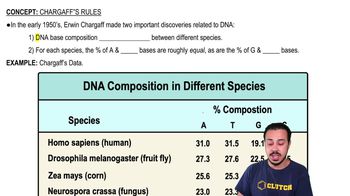
In DNA, nitrogenous bases pair specifically: adenine (A) pairs with thymine (T), and cytosine (C) pairs with guanine (G). This complementary base pairing is essential for DNA structure and replication.
Recommended video:
Guided course
04:33
Chargaff's Rules

Hydrogen Bonding Between Bases

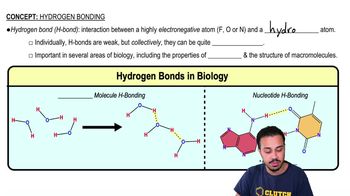
Hydrogen bonds stabilize the DNA double helix by connecting complementary bases. Adenine and thymine form two hydrogen bonds, while cytosine and guanine form three, influencing DNA stability.
Recommended video:
Guided course
05:03
Hydrogen Bonding

Difference Between DNA and RNA Bases

DNA contains thymine as a base, whereas RNA contains uracil instead of thymine. This distinction is important when identifying correct base pairing in DNA versus RNA molecules.
Recommended video:
Guided course
02:30
Introduction to DNA-Based Technology