
Ch. 10 - Controlling Microbial Growth in the Body: Antimicrobial Drugs
Bauman - Microbiology with Diseases by Taxonomy 6th Edition
Bauman6th EditionMicrobiology with Diseases by TaxonomyISBN: 9780134832302Not the one you use?Change textbook
Chapter 10, Problem 2

What specific test for antimicrobial efficacy is shown? What does this test measure? Draw an oval to predict the size and shape of the zone of inhibition if the drug concentration on the strip were increased twofold.
<IMAGE>

Verified step by step guidance
1
Identify the test shown in the image based on common antimicrobial susceptibility methods. The description suggests it is likely the E-test (Epsilometer test), which uses a strip impregnated with a gradient of antibiotic concentrations.
Understand what the E-test measures: it determines the Minimum Inhibitory Concentration (MIC) of an antibiotic against a specific microorganism by observing where bacterial growth is inhibited along the strip.
Recall that the zone of inhibition in the E-test forms an elliptical shape around the strip, with the point where bacterial growth touches the strip indicating the MIC value.
To predict the effect of doubling the drug concentration on the strip, consider that higher antibiotic concentration generally increases the size of the inhibition zone, but the shape remains elliptical due to the gradient nature of the strip.
Draw an oval-shaped zone of inhibition around the strip, larger than the original, maintaining the elliptical shape but extending further from the strip to represent the increased antimicrobial effect at higher concentration.

Verified video answer for a similar problem:

This video solution was recommended by our tutors as helpful for the problem above.
Video duration:
2m
Was this helpful?

Key Concepts

Here are the essential concepts you must grasp in order to answer the question correctly.

Antimicrobial Susceptibility Testing

This testing determines the effectiveness of antibiotics or antimicrobial agents against specific bacteria. It helps identify which drugs can inhibit or kill the microorganism, guiding appropriate treatment choices.
Recommended video:
Guided course
06:59
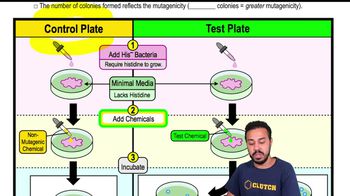
The Ames Test

Zone of Inhibition

The zone of inhibition is the clear area around an antimicrobial agent where bacterial growth is prevented. Its size and shape indicate the drug's efficacy and diffusion rate in the medium.
Recommended video:
Guided course
05:03
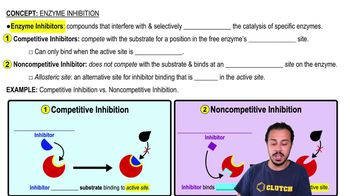
Enzyme Inhibition

Effect of Drug Concentration on Zone Size

Increasing the concentration of an antimicrobial agent typically enlarges the zone of inhibition, as higher drug levels inhibit bacteria over a greater area. This relationship helps predict changes in zone dimensions with varying drug doses.
Recommended video:
Guided course
04:51
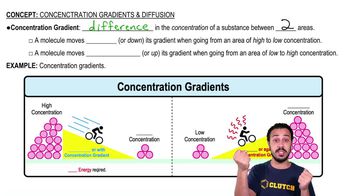
Concentration Gradients and Diffusion
Related Practice
Textbook Question

In a Kirby-Bauer susceptibility test, the presence of a zone of inhibition around disks containing antimicrobial agents indicates __________ .

a. That the microbe does not grow in the presence of the agents

b. That the microbe grows well in the presence of the agents

c. The smallest amount of the agent that will inhibit the growth of the microbe

d. The minimum amount of an agent that kills the microbe in question

1371
views
Textbook Question

Given that both human cells and pathogens synthesize proteins at ribosomal sites, how can antimicrobial agents that target this process be safe to use in humans?

760
views
Textbook Question

Label each of the accompanying figures to indicate the class of drug that is stopping polypeptide translation.


<IMAGE> <IMAGE>

a. ________________ b. _________________

block initiation. change 30S subunit.


<IMAGE> <IMAGE>

c. ________________ d. _________________

block ribosome attachment inhibits peptide bonding


<IMAGE> <IMAGE>

e. ________________ g. _________________

f. ________________ h. _________________

block ribosome movement block tRNA docking

709
views
Textbook Question

Why is the fact that drug Z destroys the NAM portions of a cell’s wall structure an important factor in considering the drug for chemotherapy?

708
views
Textbook Question

Contrast narrow-spectrum and broad-spectrum drugs. Which are more effective?

781
views
Textbook Question

The key to successful chemotherapy is __________ .

a. Selective toxicity

b. A diffusion test

c. The minimum inhibitory concentration test

d. The spectrum of action

861
views