
Textbook Question
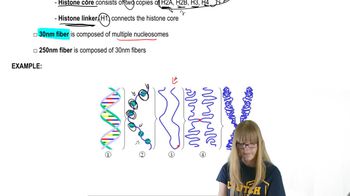
Describe the molecular composition and arrangement of the components in the nucleosome.
697
views

 Verified step by step guidance
 07:10
07:10
 04:35 04:35
Describe the molecular composition and arrangement of the components in the nucleosome.
Assume that a viral DNA molecule is a 50-µm-long circular strand with a uniform 20-Å diameter. If this molecule is contained in a viral head that is a 0.08-µm-diameter sphere, will the DNA molecule fit into the viral head, assuming complete flexibility of the molecule? Justify your answer mathematically.
Mammals contain a diploid genome consisting of at least 10⁹ bp. If this amount of DNA is present as chromatin fibers, where each group of 200 bp of DNA is combined with 9 histones into a nucleosome and each group of 6 nucleosomes is combined into a solenoid, achieving a final packing ratio of 50, determine:
(a) the total number of nucleosomes in all fibers,
(b) the total number of histone molecules combined with DNA in the diploid genome, and
(c) the combined length of all fibers.
Describe the sequence of research findings that led to the development of the model of chromatin structure.
Why might we predict that the organization of eukaryotic genetic material will be more complex than that of viruses or bacteria?
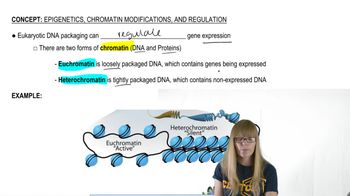
Provide a comprehensive definition of heterochromatin and list as many examples as you can.