Ch. 10 - DNA Structure and Analysis
Klug - Concepts of Genetics  12th Edition
Klug12th EditionConcepts of Genetics ISBN: 9780135564776Not the one you use?Change textbook
Chapter 10, Problem 10

Draw the chemical structure of the three components of a nucleotide, and then link the three together. What atoms are removed from the structures when the linkages are formed?

Verified step by step guidance
1
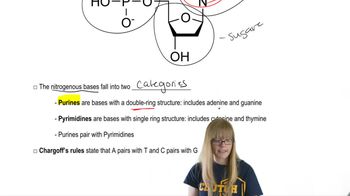
Identify the three components of a nucleotide: a nitrogenous base, a five-carbon sugar (deoxyribose in DNA or ribose in RNA), and a phosphate group.
Draw the chemical structure of the nitrogenous base, which can be a purine (adenine or guanine) or a pyrimidine (cytosine, thymine, or uracil). These bases contain nitrogen and carbon atoms arranged in one or two rings.
Draw the five-carbon sugar structure, showing the carbon atoms numbered 1' through 5'. The sugar has hydroxyl (-OH) groups attached, with the 1' carbon linked to the nitrogenous base and the 5' carbon linked to the phosphate group.
Draw the phosphate group as a phosphorus atom bonded to four oxygen atoms, one of which forms a bond with the 5' carbon of the sugar.
Explain the formation of the nucleotide by linking the nitrogenous base to the sugar via a glycosidic bond (between the 1' carbon of the sugar and a nitrogen atom of the base), and linking the phosphate group to the sugar via a phosphoester bond (between the phosphate and the 5' carbon of the sugar). During these linkages, a water molecule (H₂O) is removed in each condensation reaction: one when the base attaches to the sugar and one when the phosphate attaches to the sugar.

Verified video answer for a similar problem:

This video solution was recommended by our tutors as helpful for the problem above.
Video duration:
1m
Was this helpful?

Key Concepts

Here are the essential concepts you must grasp in order to answer the question correctly.

Components of a Nucleotide

A nucleotide consists of three parts: a nitrogenous base (adenine, thymine, cytosine, guanine, or uracil), a five-carbon sugar (deoxyribose in DNA or ribose in RNA), and one or more phosphate groups. Each component has a distinct chemical structure essential for forming nucleic acids.
Recommended video:
Guided course
06:25
DNA Structure

Phosphodiester Bond Formation

Nucleotides link together via phosphodiester bonds, which connect the 3' hydroxyl group of one sugar to the 5' phosphate group of the next. This linkage forms the sugar-phosphate backbone of DNA or RNA, creating a stable chain essential for genetic information storage.
Recommended video:
Guided course
04:06
Formation of Plant Gametes

Dehydration Synthesis in Nucleotide Linking

When nucleotides join, a dehydration reaction occurs, removing a water molecule (H2O). Specifically, a hydroxyl group (OH) from the sugar and a hydrogen (H) from the phosphate group are lost, enabling the formation of the phosphodiester bond that links nucleotides.
Recommended video:
Guided course
07:56
Sex-Linked Genes