Ch. 10 - DNA Structure and Analysis
Klug - Concepts of Genetics  12th Edition
Klug12th EditionConcepts of Genetics ISBN: 9780135564776Not the one you use?Change textbook
Chapter 10, Problem 7

Does the design of the Hershey–Chase experiment distinguish between DNA and RNA as the molecule serving as the genetic material? Why or why not?

Verified step by step guidance
1
Step 1: Understand the goal of the Hershey–Chase experiment, which was to determine whether DNA or protein is the genetic material in bacteriophages (viruses that infect bacteria).
Step 2: Review the experimental design: Hershey and Chase used two different radioactive isotopes to label the components of the phage. They labeled DNA with radioactive phosphorus-32 (\(^{32}P\)) because DNA contains phosphorus, and they labeled protein with radioactive sulfur-35 (\(^{35}S\)) because proteins contain sulfur but DNA does not.
Step 3: Analyze what happens during the experiment: After allowing the labeled phages to infect bacteria, they used a blender to separate the phage protein coats from the bacterial cells and then measured radioactivity in the bacteria and in the phage coats.
Step 4: Consider whether the experiment distinguishes DNA from RNA: Since the radioactive label for nucleic acids was phosphorus-32, which labels all nucleic acids (both DNA and RNA contain phosphorus), the experiment does not specifically distinguish DNA from RNA. It only distinguishes nucleic acids from proteins.
Step 5: Conclude that the Hershey–Chase experiment demonstrated that nucleic acids (DNA or RNA) enter the bacterial cells and carry genetic information, but it does not differentiate between DNA and RNA as the genetic material. Additional evidence was needed to confirm that DNA, not RNA, is the genetic material.

Verified video answer for a similar problem:

This video solution was recommended by our tutors as helpful for the problem above.
Video duration:
2m
Was this helpful?

Key Concepts

Here are the essential concepts you must grasp in order to answer the question correctly.

Hershey–Chase Experiment Design

The Hershey–Chase experiment used bacteriophages labeled with radioactive isotopes to track DNA and protein during infection. Phosphorus-32 labeled DNA, while sulfur-35 labeled protein, allowing researchers to determine which molecule entered bacterial cells. This design specifically tested DNA versus protein, not RNA.
Recommended video:
Guided course
08:06
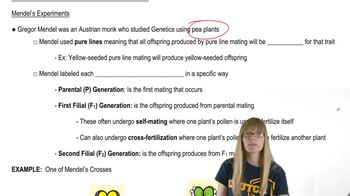
Mendel's Experiments

Distinction Between DNA and RNA

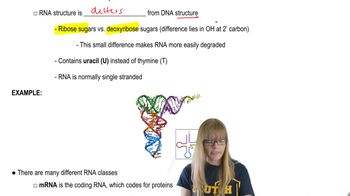
DNA and RNA are both nucleic acids but differ chemically; DNA contains deoxyribose sugar, while RNA contains ribose. The Hershey–Chase experiment did not differentiate between DNA and RNA because it only labeled DNA with phosphorus-32, assuming DNA was the nucleic acid present in phages, not considering RNA as genetic material.
Recommended video:

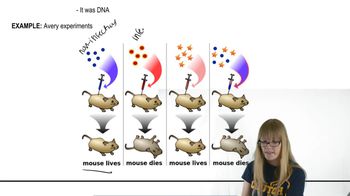
Identification of Genetic Material

The experiment demonstrated that DNA, not protein, entered bacterial cells and directed viral replication, supporting DNA as the genetic material. However, it did not explicitly rule out RNA because RNA was not labeled or tested, so the experiment distinguished DNA from protein but not DNA from RNA.
Recommended video:
Guided course
09:32
History and Experiments