
Textbook Question
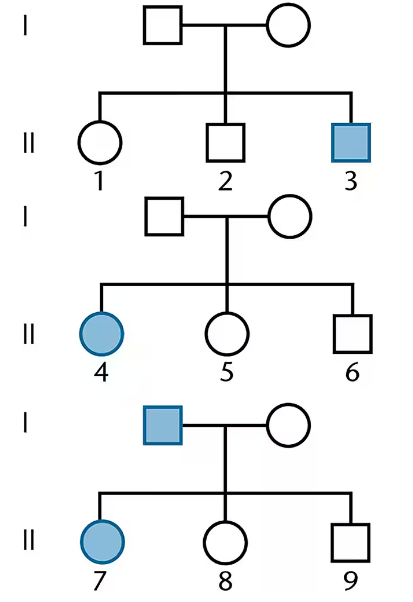
Consider the three pedigrees below, all involving a single human trait.
Which combination of conditions, if any, can be excluded? dominant and X-linked dominant and autosomal recessive and X-linked recessive and autosomal
624
views

 Verified step by step guidance
 01:59
01:59
 04:37
04:37 07:52
07:52Consider the three pedigrees below, all involving a single human trait.
Which combination of conditions, if any, can be excluded? dominant and X-linked dominant and autosomal recessive and X-linked recessive and autosomal
In a cross in Drosophila involving the X-linked recessive eye mutation white and the autosomally linked recessive eye mutation sepia (resulting in a dark eye), predict the F₁ and F₂ results of crossing true-breeding parents of the following phenotypes: Note that white is epistatic to the expression of sepia.
sepia females x white males
Two mothers give birth to sons at the same time at a busy urban hospital. The son of mother 1 is afflicted with hemophilia, a disease caused by an X-linked recessive allele. Neither parent has the disease. Mother 2 has a normal son, despite the fact that the father has hemophilia. Several years later, couple 1 sues the hospital, claiming that these two newborns were swapped in the nursery following their birth. As a genetic counselor, you are called to testify. What information can you provide the jury concerning the allegation?
Predict the F₁ and F₂ results of crossing a male fowl that is cock-feathered with a true-breeding hen-feathered female fowl. Recall that these traits are sex limited.
Consider the three pedigrees below, all involving a single human trait.
For each combination that you excluded, indicate the single individual in generation II (e.g., II-1, II-2) that was most instrumental in your decision to exclude it. If none were excluded, answer 'none apply.'
In goats, the development of the beard is due to a recessive gene. The following cross involving true-breeding goats was made and carried to the F₂ generation:
Offer an explanation for the inheritance and expression of this trait, diagramming the cross. Propose one or more crosses to test your hypothesis.