Textbook Question
What roles have inversions and translocations played in the evolutionary process?
916
views

 Klug 12th EditionCh. 8 - Chromosome Mutations: Variation in Number and ArrangementProblem 12
 Verified step by step guidance
 04:18
04:18
 05:05
05:05 11:19
11:19Contrast the genetic composition of gametes derived from tetrads of inversion heterozygotes where crossing over occurs within a paracentric versus a pericentric inversion.
Inversions are said to 'suppress crossing over.' Is this terminology technically correct? If not, restate the description accurately.
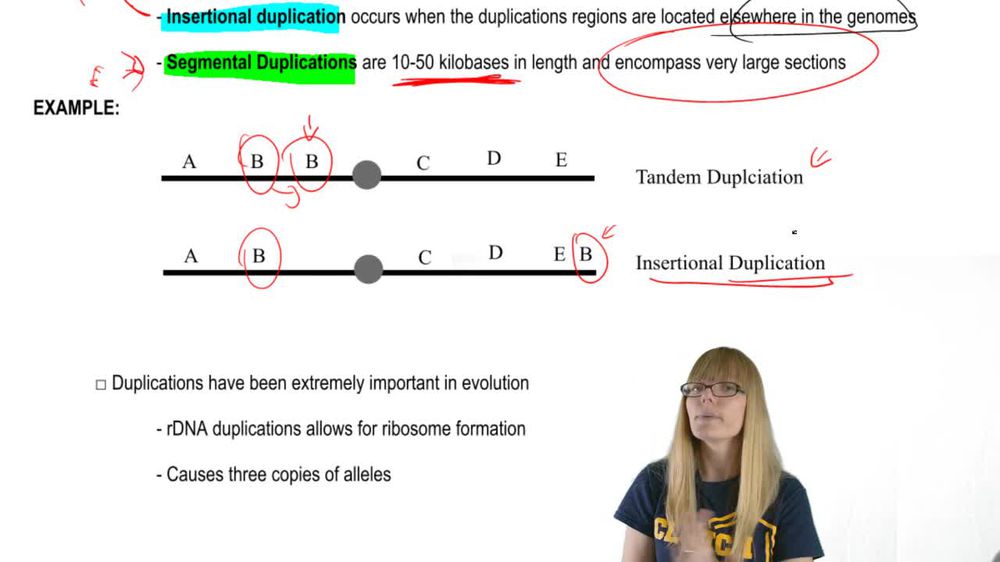
Discuss Ohno's hypothesis on the role of gene duplication in the process of evolution. What evidence supports this hypothesis?
The primrose, Primula kewensis, has 36 chromosomes that are similar in appearance to the chromosomes in two related species, P. floribunda (2n=18) and P. verticillata (2n=18). How could P. kewensis arise from these species? How would you describe P. kewensis in genetic terms?
Predict how the synaptic configurations of homologous pairs of chromosomes might appear when one member is normal and the other member has sustained a deletion or duplication.