
Electrophoresis is an extremely useful procedure when applied to analysis of nucleic acids as it can resolve molecules of different sizes with relative ease and accuracy. Large molecules migrate more slowly than small molecules in agarose gels. However, the fact that nucleic acids of the same length may exist in a variety of conformations can often complicate the interpretation of electrophoretic separations. For instance, when a single species of a bacterial plasmid is isolated from cells, the individual plasmids may exist in three forms (depending on the genotype of their host and conditions of isolation): superhelical/supercoiled (form I), nicked/open circle (form II), and linear (form III). Form I is compact and very tightly coiled, with both DNA strands continuous. Form II exists as a loose circle because one of the two DNA strands has been broken, thus releasing the supercoil. All three have the same mass, but each will migrate at a different rate through a gel. Based on your understanding of gel composition and DNA migration, predict the relative rates of migration of the three DNA structures mentioned above.

- Ch. 1 - Introduction to Genetics17
- Ch. 2 - Mitosis and Meiosis36
- Ch. 3 - Mendelian Genetics51
- Ch. 4 - Extensions of Mendelian Genetics74
- Ch. 5 - Chromosome Mapping in Eukaryotes51
- Ch. 6 - Genetic Analysis and Mapping in Bacteria and Bacteriophages46
- Ch. 7 - Sex Determination and Sex Chromosomes33
- Ch. 8 - Chromosome Mutations: Variation in Number and Arrangement40
- Ch. 9 - Extranuclear Inheritance31
- Ch. 10 - DNA Structure and Analysis43
- Ch. 11 - DNA Replication and Recombination44
- Ch. 12 - DNA Organization in Chromosomes30
- Ch. 13 - The Genetic Code and Transcription54
- Ch. 14 - Translation and Proteins47
- Ch. 15 - Gene Mutation, DNA Repair, and Transposition41
- Ch. 16 - Regulation of Gene Expression in Bacteria29
- Ch. 17 - Transcriptional Regulation in Eukaryotes41
- Ch. 18 - Post-transcriptional Regulation in Eukaryotes33
- Ch. 19 - Epigenetics33
- Ch. 20 - Recombinant DNA Technology44
- Ch. 21 - Genomic Analysis36
- Ch. 22 - Applications of Genetic Engineering and Biotechnology36
- Ch. 23 - Developmental Genetics37
- Ch. 24 - Cancer Genetics34
- Ch. 25 - Quantitative Genetics and Multifactorial Traits54
- Ch. 26 - Population and Evolutionary Genetics45
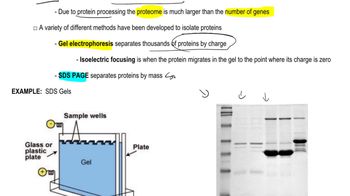
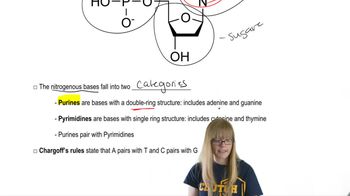
During gel electrophoresis, DNA molecules can easily be separated according to size because all DNA molecules have the same charge-to-mass ratio and the same shape (long rod). Would you expect RNA molecules to behave in the same manner as DNA during gel electrophoresis? Why or why not?
 Verified step by step guidance
Verified video answer for a similar problem:

Key Concepts
Charge-to-Mass Ratio of Nucleic Acids
 06:36
06:36
Molecular Structure and Shape of DNA vs. RNA
 06:25
06:25Effect of Secondary Structure on Electrophoretic Mobility
 03:38
03:38Newsdate: March 1, 2030. A unique creature has been discovered during exploration of outer space. Recently, its genetic material has been isolated and analyzed. This material is similar in some ways to DNA in its chemical makeup. It contains in abundance the 4-carbon sugar erythrose and a molar equivalent of phosphate groups. In addition, it contains six nitrogenous bases: adenine (A), guanine (G), thymine (T), cytosine (C), hypoxanthine (H), and xanthine (X). These bases exist in the following relative proportions:
A =T = H and C = G = X
X-ray diffraction studies have established a regularity in the molecule and a constant diameter of about 30 Å. Together, these data have suggested a model for the structure of this molecule.
Given the constant diameter of 30 Å, do you think that either (i) both H and X are purines or both pyrimidines, or (ii) one is a purine and one is a pyrimidine?
Newsdate: March 1, 2030. A unique creature has been discovered during exploration of outer space. Recently, its genetic material has been isolated and analyzed. This material is similar in some ways to DNA in its chemical makeup. It contains in abundance the 4-carbon sugar erythrose and a molar equivalent of phosphate groups. In addition, it contains six nitrogenous bases: adenine (A), guanine (G), thymine (T), cytosine (C), hypoxanthine (H), and xanthine (X). These bases exist in the following relative proportions:
A =T = H and C = G = X
X-ray diffraction studies have established a regularity in the molecule and a constant diameter of about 30 Å. Together, these data have suggested a model for the structure of this molecule.
Propose a general model of this molecule. Describe it briefly.
Newsdate: March 1, 2030. A unique creature has been discovered during exploration of outer space. Recently, its genetic material has been isolated and analyzed. This material is similar in some ways to DNA in its chemical makeup. It contains in abundance the 4-carbon sugar erythrose and a molar equivalent of phosphate groups. In addition, it contains six nitrogenous bases: adenine (A), guanine (G), thymine (T), cytosine (C), hypoxanthine (H), and xanthine (X). These bases exist in the following relative proportions:
A =T = H and C = G = X
X-ray diffraction studies have established a regularity in the molecule and a constant diameter of about 30 Å. Together, these data have suggested a model for the structure of this molecule.
What base-pairing properties must exist for H and for X in the model?