
Textbook Question
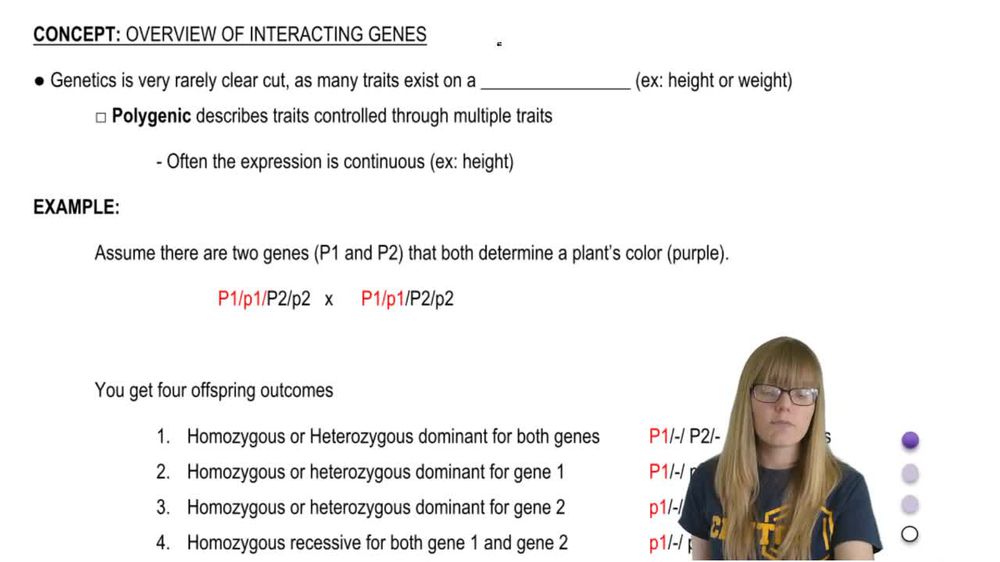
Write a short essay that discusses the difference between the more traditional Mendelian and neo-Mendelian modes of inheritance (qualitative inheritance) and quantitative inheritance.
448
views

 Verified step by step guidance
 07:56
07:56
 03:03
03:03 07:04
07:04Write a short essay that discusses the difference between the more traditional Mendelian and neo-Mendelian modes of inheritance (qualitative inheritance) and quantitative inheritance.
How do we know that monozygotic twins are not identical genotypically as adults?
How do we assess environmental factors to determine if they impact the phenotype of a quantitatively inherited trait?
A dark-red strain and a white strain of wheat are crossed and produce an intermediate, medium-red F₁. When the F₁ plants are interbred, an F₂ generation is produced in a ratio of 1 dark-red: 4 medium-dark-red: 6 medium-red: 4 light-red: 1 white. Further crosses reveal that the dark-red and white F₂ plants are true breeding
Assign symbols to these alleles, and list possible genotypes that give rise to the medium-red and light-red phenotypes.
A dark-red strain and a white strain of wheat are crossed and produce an intermediate, medium-red F₁. When the F₁ plants are interbred, an F₂ generation is produced in a ratio of 1 dark-red: 4 medium-dark-red: 6 medium-red: 4 light-red: 1 white. Further crosses reveal that the dark-red and white F₂ plants are true breeding
Based on the ratios in the F₂ population, how many genes are involved in the production of color?
A dark-red strain and a white strain of wheat are crossed and produce an intermediate, medium-red F₁. When the F₁ plants are interbred, an F₂ generation is produced in a ratio of 1 dark-red: 4 medium-dark-red: 6 medium-red: 4 light-red: 1 white. Further crosses reveal that the dark-red and white F₂ plants are true breeding
How many additive alleles are needed to produce each possible phenotype?