
A 100.0-mL aqueous sodium chloride solution is 13.5% NaCl by mass and has a density of 1.12 g/mL. What would you add (solute or solvent) and what mass of it to make the boiling point of the solution 104.4 °C? (Use i = 1.8 for NaCl.)
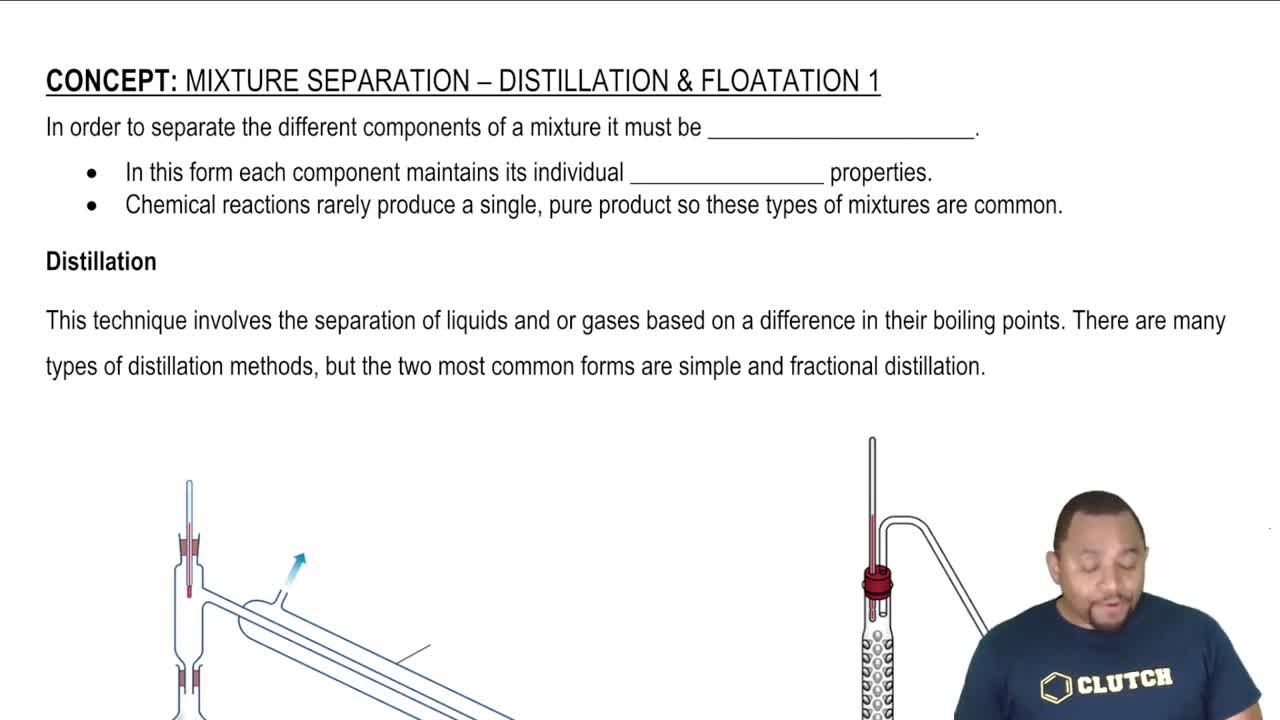
Use the result of the previous problem to calculate the mole fraction of chloroform in the vapor above a solution obtained by three successive separations and condensations of the vapors above the original solution of carbon tetrachloride and chloroform. Show how this result explains the use of distillation as a separation method.
Verified step by step guidanceKey Concepts
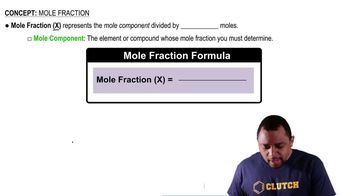
Mole Fraction
Distillation
Vapor-Liquid Equilibrium
The osmotic pressure of a solution containing 2.10 g of an unknown compound dissolved in 175.0 mL of solution at 25 °C is 1.93 atm. The combustion of 24.02 g of the unknown compound produced 28.16 g CO2 and 8.64 g H2O. What is the molecular formula of the compound (which contains only carbon, hydrogen, and oxygen)?
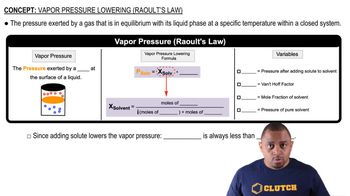
A solution of a nonvolatile solute in water has a boiling point of 375.3 K. Calculate the vapor pressure of water above this solution at 338 K. The vapor pressure of pure water at this temperature is 0.2467 atm.
The vapor pressure of carbon tetrachloride, CCl4, is 0.354 atm, and the vapor pressure of chloroform, CHCl3, is 0.526 atm at 316 K. A solution is prepared from equal masses of these two compounds at this temperature. Calculate the mole fraction of the chloroform in the vapor above the solution. If the vapor above the original solution is condensed and isolated into a separate flask, what will the vapor pressure of chloroform be above this new solution?
