
Here are the essential concepts you must grasp in order to answer the question correctly.
Morphospecies Concept
The morphospecies concept identifies species based on distinct morphological characteristics, such as size, shape, or coloration. This approach is often used when genetic or reproductive data are unavailable, especially in paleontology, where fossils are analyzed for unique physical traits to classify species.
Recommended video:
Biological Species Concept
Phylogenetic Species Concept
The phylogenetic species concept defines a species as the smallest group of individuals that share a common ancestor, forming a distinct branch on the phylogenetic tree. This concept emphasizes evolutionary relationships and genetic distinctiveness, using molecular data to trace lineage divergence and species identification.
Recommended video:
Biological Species Concept
Reproductive Isolation
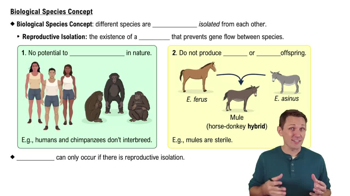
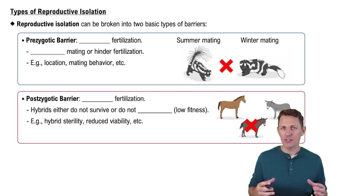
Reproductive isolation is a key mechanism in the biological species concept, where species are defined by their inability to interbreed and produce viable offspring with other groups. This isolation can be due to physical, behavioral, or genetic barriers, ensuring that distinct species maintain separate evolutionary paths.
Recommended video:
Types of Reproductive Isolation