
Ch. 24 - Speciation
Freeman - Biological Science 8th Edition
Freeman8th EditionBiological ScienceISBN: 9780138276263Not the one you use?Change textbook
Chapter 24, Problem 3

Select True or False to indicate which of the following groups could be identified using the biological species concept.
T/F lizard species living today
T/F sunflower species living today
T/F extinct dinosaurs
T/F bacteria living today

Verified step by step guidance
1
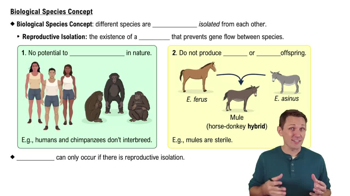
Understand the biological species concept: It defines a species as a group of organisms that can interbreed and produce fertile offspring in natural conditions.
Consider lizard species living today: Since they are living organisms, we can observe their ability to interbreed and produce fertile offspring, making it possible to identify them using the biological species concept.
Consider sunflower species living today: Like lizards, sunflowers are living organisms, and their ability to interbreed and produce fertile offspring can be observed, allowing identification using the biological species concept.
Consider extinct dinosaurs: Since they are extinct, we cannot observe their ability to interbreed and produce fertile offspring, making it impossible to identify them using the biological species concept.
Consider bacteria living today: Bacteria reproduce asexually, which does not fit the biological species concept that relies on sexual reproduction and interbreeding, making it challenging to identify them using this concept.

Verified video answer for a similar problem:

This video solution was recommended by our tutors as helpful for the problem above.
Video duration:
36s
Was this helpful?

Key Concepts

Here are the essential concepts you must grasp in order to answer the question correctly.

Biological Species Concept

The Biological Species Concept defines a species as a group of individuals that can interbreed and produce fertile offspring in natural conditions. This concept emphasizes reproductive isolation as a key factor in maintaining species boundaries. It is most applicable to sexually reproducing organisms and is less useful for asexual organisms or fossils.
Recommended video:
03:24
Biological Species Concept

Reproductive Isolation

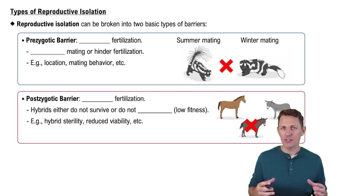
Reproductive isolation is a collection of mechanisms that prevent different species from interbreeding. These mechanisms can be prezygotic, such as temporal or behavioral isolation, or postzygotic, such as hybrid sterility. Reproductive isolation is crucial for the Biological Species Concept, as it maintains the genetic distinctiveness of species.
Recommended video:
02:47
Types of Reproductive Isolation

Limitations of the Biological Species Concept

The Biological Species Concept has limitations, particularly with asexual organisms, fossils, and species that hybridize. It cannot be applied to extinct species like dinosaurs, as reproductive behaviors cannot be observed. Similarly, it is not suitable for bacteria, which reproduce asexually and do not fit the interbreeding criterion.
Recommended video:
03:24
Biological Species Concept
Related Practice
Textbook Question

What distinguishes a morphospecies?

a. It has distinctive characteristics, such as size, shape, or coloration.

b. It represents a distinct branch in a phylogeny of populations.

c. It is reproductively isolated from other species.

d. It is a fossil from a distinct time in Earth history.

1218
views
Textbook Question

Which of the following describes vicariance?

a. Small populations coalesce into one large population.

b. A population is fragmented into isolated subpopulations.

c. Individuals colonize a novel habitat.

d. Individuals disperse and found a new population.

582
views
Textbook Question

Evaluate this statement: Gene flow increases the genetic divergence of populations.

1114
views
Textbook Question

When the ranges of two different species meet, a stable 'hybrid zone' occupied by hybrid individuals may form. How is this possible?

a. Two diverged populations are capable of mating and producing viable and fertile offspring.

b. Hybrid individuals are always allopolyploid and are thus unable to mate with either of the original species.

c. Hybrid individuals may have reduced fitness and thus be strongly selected against.

d. One species has a selective advantage, so as hybridization continues, the other species will go extinct.

715
views
Textbook Question

Sexual selection favors individuals with traits that increase their ability to obtain mates, such as mating calls in crickets. Using this example, propose a scenario where sexual selection could contribute to divergence in sympatric speciation.

823
views