Ch. 11 - Cell-Cell Interactions
Freeman - Biological Science 8th Edition
Freeman8th EditionBiological ScienceISBN: 9780138276263Not the one you use?Change textbook
Chapter 11, Problem 3

Which of the following actions correctly describe a role performed by at least one type of intercellular connection? Select True or False for each statement.
T/FAllows communication between adjacent cells.
T/FForms a watertight barrier between the cells.
T/FUses components of the extracellular matrix to indirectly connect adjacent cells.
T/FAssociates with cytoskeletal components to resist pulling forces.

Verified step by step guidance
1
Understand the types of intercellular connections: gap junctions, tight junctions, desmosomes, and hemidesmosomes, each with distinct roles.
Gap junctions allow communication between adjacent cells by permitting the passage of ions and small molecules. This statement is True.
Tight junctions form a watertight barrier between cells, preventing the passage of substances between them. This statement is True.
Desmosomes use components of the extracellular matrix to indirectly connect adjacent cells, providing structural support. This statement is True.
Desmosomes and hemidesmosomes associate with cytoskeletal components to resist pulling forces, providing mechanical stability. This statement is True.

Verified video answer for a similar problem:

This video solution was recommended by our tutors as helpful for the problem above.
Video duration:
3m
Was this helpful?

Key Concepts

Here are the essential concepts you must grasp in order to answer the question correctly.

Intercellular Connections

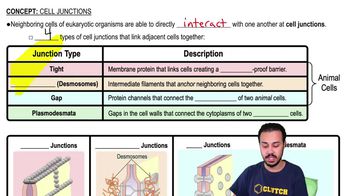
Intercellular connections are structures that facilitate interaction between adjacent cells. They include tight junctions, gap junctions, and desmosomes, each serving distinct functions such as communication, forming barriers, or providing structural support. Understanding these connections is crucial for determining how cells interact and maintain tissue integrity.
Recommended video:
Guided course
02:28
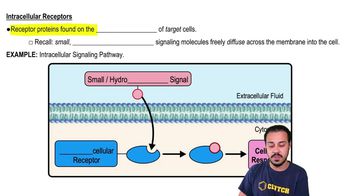
Intracellular Receptors

Tight Junctions

Tight junctions are specialized connections between epithelial cells that create a watertight seal, preventing the passage of molecules and ions through the space between cells. This barrier function is essential in maintaining distinct environments on either side of the epithelial layer, such as in the intestines or blood-brain barrier.
Recommended video:
Guided course
05:33
Cell Junctions

Gap Junctions

Gap junctions are intercellular channels that allow direct communication between adjacent cells by permitting the passage of ions and small molecules. These junctions are crucial for coordinating activities such as electrical signaling in cardiac and smooth muscle tissues, enabling synchronized contraction and function.
Recommended video:
Guided course
05:33
Cell Junctions