Ch. 15 - Microbial Mechanisms of Pathogenicity
Tortora - Microbiology: An Introduction 14th Edition
Tortora14th EditionMicrobiology: An IntroductionISBN: 9780138200398Not the one you use?Change textbook
Chapter 15, Problem 1

Compare pathogenicity with virulence.

Verified step by step guidance
1
Step 1: Define pathogenicity as the ability of a microorganism to cause disease in a host. It is a qualitative concept indicating whether an organism can cause disease or not.
Step 2: Define virulence as the degree or extent of pathogenicity, which reflects how severe or harmful the disease caused by the microorganism is. Virulence is a quantitative measure.
Step 3: Explain that pathogenicity is a broader term describing the presence or absence of disease-causing potential, while virulence specifies the intensity or severity of the disease.
Step 4: Provide examples to illustrate the difference: for instance, a pathogen with high pathogenicity can cause disease, but its virulence determines if the disease is mild or severe.
Step 5: Summarize by stating that pathogenicity answers 'can it cause disease?' and virulence answers 'how bad is the disease caused?'

Verified video answer for a similar problem:

This video solution was recommended by our tutors as helpful for the problem above.
Video duration:
2m
Was this helpful?

Key Concepts

Here are the essential concepts you must grasp in order to answer the question correctly.

Pathogenicity

Pathogenicity refers to the ability of a microorganism to cause disease in a host. It is a qualitative trait indicating whether an organism can infect and produce disease symptoms, often determined by the presence of specific virulence factors.
Recommended video:
Guided course
03:40
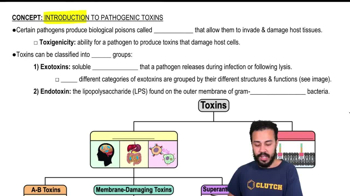
Introduction to Pathogenic Toxins

Virulence

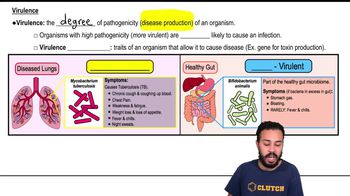
Virulence describes the degree or severity of disease caused by a pathogen. It is a quantitative measure reflecting how harmful or aggressive the microorganism is, often influenced by factors like toxin production, invasiveness, and immune evasion.
Recommended video:

Relationship between Pathogenicity and Virulence

While pathogenicity indicates if a microbe can cause disease, virulence measures how severe that disease is. All virulent organisms are pathogenic, but not all pathogenic organisms have the same level of virulence. Understanding both helps in assessing infection risks and treatment strategies.
Recommended video:
Guided course
05:59
Symbiotic Relationships