Ch. 6 - Microbial Growth
Tortora - Microbiology: An Introduction 14th Edition
Tortora14th EditionMicrobiology: An IntroductionISBN: 9780138200398Not the one you use?Change textbook
Chapter 6, Problem 1

Describe binary fission.

Verified step by step guidance
1
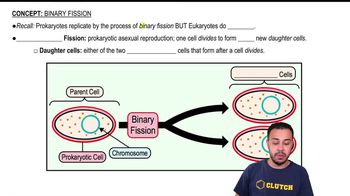
Understand that binary fission is the primary method of asexual reproduction in prokaryotic organisms such as bacteria.
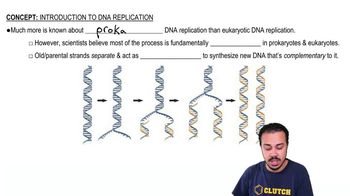
Recognize that the process begins with the replication of the bacterial chromosome, ensuring that each new cell will have a complete copy of genetic material.
Note that after DNA replication, the cell elongates, and the two chromosomes move to opposite ends (poles) of the cell.
Observe that a septum, or dividing wall, forms in the middle of the elongated cell, eventually leading to the physical separation of the two daughter cells.
Conclude that binary fission results in two genetically identical daughter cells, each capable of independent growth and reproduction.

Verified video answer for a similar problem:

This video solution was recommended by our tutors as helpful for the problem above.
Video duration:
1m
Was this helpful?

Key Concepts

Here are the essential concepts you must grasp in order to answer the question correctly.

Binary Fission Process

Binary fission is an asexual reproduction method used by prokaryotes like bacteria, where a single cell divides into two identical daughter cells. The process involves DNA replication, chromosome segregation, and cytokinesis, resulting in two genetically identical cells.
Recommended video:
Guided course
02:16
Binary Fission

DNA Replication in Prokaryotes

Before binary fission, the bacterial chromosome is duplicated to ensure each daughter cell receives a complete copy. This replication starts at a specific origin and proceeds bidirectionally, enabling accurate genetic material distribution.
Recommended video:
Guided course
03:37
Introduction to DNA Replication

Cytokinesis and Cell Division

Cytokinesis is the physical division of the cytoplasm following DNA replication and segregation. In binary fission, a septum forms at the cell center, constricting the cell membrane and wall to separate the two new cells.
Recommended video:
Guided course
04:26
Recap:Prokaryotic vs. Eukaryotic Cells