Ch. 25 - Microbial Diseases of the Digestive System
Tortora - Microbiology: An Introduction 14th Edition
Tortora14th EditionMicrobiology: An IntroductionISBN: 9780138200398Not the one you use?Change textbook
Chapter 25, Problem 1

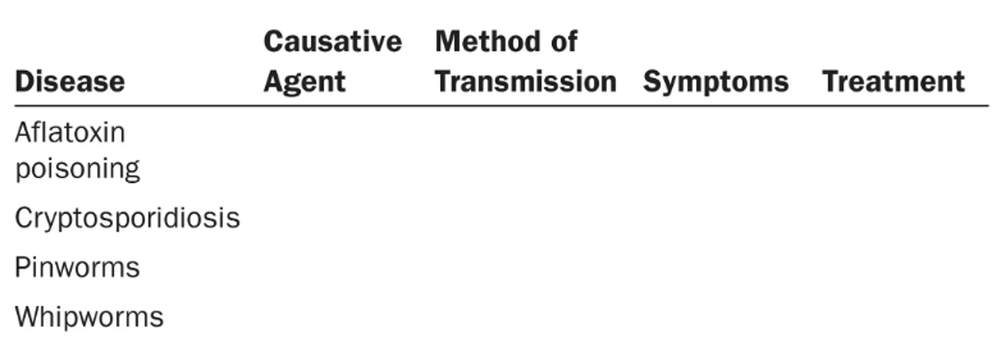
Complete the following table:
Blank table with columns for disease, causative agent, transmission method, symptoms, and treatment, listing four diseases.

Verified step by step guidance
1
Step 1: Identify the causative agent for each disease. For Aflatoxin poisoning, the causative agent is a toxin produced by certain fungi, specifically Aspergillus species. For Cryptosporidiosis, the causative agent is the protozoan parasite Cryptosporidium. For Pinworms and Whipworms, the causative agents are parasitic nematodes Enterobius vermicularis and Trichuris trichiura, respectively.
Step 2: Determine the method of transmission for each disease. Aflatoxin poisoning occurs through ingestion of contaminated food, especially grains and nuts. Cryptosporidiosis is transmitted via the fecal-oral route, often through contaminated water. Pinworms are transmitted by ingestion of eggs from contaminated surfaces or direct contact. Whipworms are transmitted by ingestion of eggs from contaminated soil or food.
Step 3: List the common symptoms associated with each disease. Aflatoxin poisoning symptoms include liver damage and potential carcinogenic effects. Cryptosporidiosis symptoms include watery diarrhea, stomach cramps, and dehydration. Pinworm infection symptoms include perianal itching and discomfort, especially at night. Whipworm infection symptoms include abdominal pain, diarrhea, and in severe cases, anemia.
Step 4: Identify the typical treatments for each disease. Aflatoxin poisoning treatment focuses on supportive care and avoiding contaminated food. Cryptosporidiosis is treated with antiparasitic medications such as nitazoxanide. Pinworm infections are treated with antihelminthic drugs like mebendazole or albendazole. Whipworm infections are also treated with antihelminthic medications such as mebendazole or albendazole.
Step 5: Organize the information into the table format, filling each column with the corresponding details for each disease: causative agent, method of transmission, symptoms, and treatment.

Verified video answer for a similar problem:

This video solution was recommended by our tutors as helpful for the problem above.
Was this helpful?

Key Concepts

Here are the essential concepts you must grasp in order to answer the question correctly.

Causative Agent

The causative agent is the specific microorganism or toxin responsible for causing a disease. Understanding the agent helps identify the nature of the disease, whether it is bacterial, viral, parasitic, or toxic. For example, aflatoxin poisoning is caused by a toxin produced by certain fungi, while pinworms and whipworms are parasitic worms.
Recommended video:
Guided course
03:24
Lipid A Causes Septic Shock

Method of Transmission

This concept explains how the disease spreads from one host to another. Transmission can occur through contaminated food or water, direct contact, vectors, or fecal-oral routes. Knowing the transmission method is crucial for prevention and control strategies, such as hygiene practices or avoiding contaminated sources.
Recommended video:
Guided course
06:29
Scientific Method

Symptoms and Treatment

Symptoms are the physical or physiological signs indicating the presence of a disease, which guide diagnosis. Treatment involves the medical interventions used to cure or manage the disease, such as antiparasitic drugs for pinworms or supportive care for toxin exposure. Recognizing symptoms and appropriate treatments is essential for effective disease management.
Recommended video:
Guided course
03:22
Chemical Gases: Ethylene Oxide