
Ch. 25 - Microbial Diseases of the Digestive System
Tortora - Microbiology: An Introduction 14th Edition
Tortora14th EditionMicrobiology: An IntroductionISBN: 9780138200398Not the one you use?Change textbook
Chapter 25, Problem 3

Identify the site colonized by the following organisms: E. granulosus, E. vermicularis, Giardia, H. pylori, hepatitis B virus, mumps virus, Rotavirus, Salmonella, Shigella, Streptococcus mutans, Trichinella spiralis, Trichuris.
<IMAGE>

Verified step by step guidance
1
Step 1: Understand the task requires identifying the specific anatomical sites colonized by each listed microorganism or parasite. This involves knowing their typical habitats within the human body.
Step 2: For each organism, recall or research its primary colonization site. For example, Helicobacter pylori colonizes the stomach lining, while Streptococcus mutans is found in the oral cavity (specifically dental plaque).
Step 3: Organize the organisms by their colonization sites such as gastrointestinal tract, oral cavity, respiratory tract, liver, or muscle tissue. This helps in visualizing and drawing their locations accurately.
Step 4: Use a human body diagram as a reference to mark each organism’s colonization site. For instance, mark Giardia in the small intestine, Hepatitis B virus in the liver, and Trichinella spiralis in muscle tissue.
Step 5: Verify each site by cross-checking with reliable microbiology or parasitology sources to ensure accuracy before finalizing the drawing.

Verified video answer for a similar problem:

This video solution was recommended by our tutors as helpful for the problem above.
Was this helpful?

Key Concepts

Here are the essential concepts you must grasp in order to answer the question correctly.

Microbial and Parasitic Colonization Sites

Understanding where microorganisms and parasites colonize in the human body is essential for diagnosing infections. Different pathogens have specific preferred sites, such as the gastrointestinal tract, oral cavity, or respiratory system, which influence their pathogenicity and transmission.
Recommended video:
Guided course
03:51
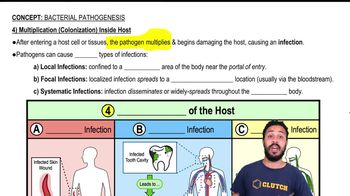
4) Multiplication (Colonization) Inside Host

Pathogen Classification and Characteristics

Recognizing the type of pathogen—bacteria, virus, or parasite—helps determine its colonization site and mode of infection. For example, Helicobacter pylori is a bacterium colonizing the stomach lining, while Giardia is a protozoan parasite inhabiting the small intestine.
Recommended video:
Guided course
03:40
Introduction to Pathogenic Toxins

Host-Pathogen Interaction and Disease Manifestation

The interaction between a pathogen and its colonization site affects disease symptoms and progression. For instance, Streptococcus mutans colonizes the oral cavity and contributes to dental caries, while hepatitis B virus targets liver cells, leading to hepatitis.
Recommended video:
Guided course
03:40
Introduction to Pathogenic Toxins