In the laboratory, blood is typed by looking for hemagglutination. For example, anti-A antibodies and type A RBCs clump. In a type A person, anti-A antibodies will cause hemolysis. Why?
Ch. 19 - Disorders Associated with the Immune System

Tortora14th EditionMicrobiology: An IntroductionISBN: 9780138200398Not the one you use?Change textbook
Chapter 19, Problem 2
What does pluripotent mean?
a. Ability of a single cell to develop into an embryonic or adult stem cell
b. Ability of a stem cell to develop into many different cell types
c. A cell without MHC I and MHC II antigens
d. Ability of a single stem cell to heal different types of diseases
e. Ability of an adult cell to become a stem cell
Verified step by step guidance1
Step 1: Understand the term 'pluripotent' in the context of stem cells. Pluripotent refers to the capability of a stem cell to differentiate into multiple, but not all, cell types.
Step 2: Recall the hierarchy of stem cell potency: totipotent (can form all cell types including extraembryonic), pluripotent (can form almost all cell types of the body), multipotent (can form a limited range of cells), and unipotent (can form only one cell type).
Step 3: Analyze each option in the question to see which best matches the definition of pluripotent. For example, option (b) mentions the ability of a stem cell to develop into many different cell types, which aligns with the concept of pluripotency.
Step 4: Eliminate options that do not relate to the differentiation potential of stem cells, such as those describing antigen presence (option c) or healing ability (option d).
Step 5: Conclude that the correct understanding of pluripotent is the ability of a stem cell to develop into many different cell types, which corresponds to option (b).

Verified video answer for a similar problem:
This video solution was recommended by our tutors as helpful for the problem above.
Video duration:
1mWas this helpful?
Key Concepts
Here are the essential concepts you must grasp in order to answer the question correctly.
Pluripotency
Pluripotency refers to the ability of a stem cell to differentiate into almost all cell types of the body, excluding extra-embryonic tissues. Pluripotent stem cells can give rise to cells from all three germ layers: ectoderm, mesoderm, and endoderm, making them crucial in developmental biology and regenerative medicine.
Stem Cell Potency Hierarchy
Stem cells vary in potency, which describes their differentiation potential. Totipotent cells can form all cell types including extra-embryonic tissues, pluripotent cells can form nearly all body cells, multipotent cells differentiate into a limited range of cells, and unipotent cells produce only one cell type.
Recommended video:
Guided course
Hierarchy of Microbial Growth Control Terminology
Major Histocompatibility Complex (MHC) Antigens
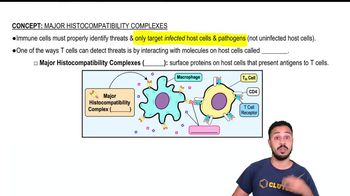
MHC I and MHC II are molecules on cell surfaces important for immune recognition. Cells lacking these antigens may evade immune detection but this characteristic is unrelated to pluripotency. Understanding MHC is essential in immunology and transplantation biology.
Recommended video:
Guided course
Major Histocompatibility Complex Molecules
Related Practice
Textbook Question
1549
views
Textbook Question
Cytotoxic autoimmunity differs from immune complex autoimmunity in that cytotoxic reactions
a. Involve antibodies
b. Do not involve complement
c. Are caused by T cells
d. Do not involve IgE antibodies
e. None of the above
952
views
Textbook Question
Desensitization to prevent an allergic response can be accomplished by injecting small, repeated doses of:
a. IgE antibodies
b. The antigen (allergen)
c. Histamine
d. IgG antibodies
e. Antihistamine
1086
views
Textbook Question
Discuss the roles of antibodies and antigens in an incompatible tissue transplant.
1452
views
Textbook Question
Explain what happens when a person develops a contact sensitivity to the poison oak plant.
a. What causes the observed symptoms?
b. How did the sensitivity develop?
c. How might this person be desensitized to poison oak?
1481
views